The way a swing ticket is fixed to a garment shapes the first impression on the rail, the speed of your packing line and whether the fabric survives unmarked. Here is a practical overview of fastening options, placement and the small dimensions that make a tag hang properly.
As a manufacturer of hang tags, strings and seals, we see the same question from almost every new brand: “How should this tag actually go on?” The answer depends on three things – the fabric, the volume you tag each day and the look you want in store.
Start with the fabric, not the tag
Before choosing a fastener, pick up the garment and ask how it reacts to a puncture. A pair of raw denim jeans or a fleece hoodie will hide a small hole easily. A silk camisole, a lace bralette or a fine merino jumper will not – a needle can split a yarn loop and start a ladder that spreads with wear. For sensitive materials, the safest route is to avoid the face fabric altogether and use an existing opening or the sewn-in label.
Fastening options at a glance
| Fastener | Typical garments | Strength | Keep in mind |
|---|---|---|---|
| Cotton, waxed or jute cord | Jeans, overshirts, workwear, eco collections | Natural, crafted look; no hole when tied through a buttonhole | Hand-tying is slow – order pre-knotted loops |
| Satin or grosgrain ribbon | Lingerie, occasionwear, gift items | Soft and refined | Ends should be heat-sealed against fraying |
| Elastic loop | Cardigans, buttoned knitwear, shirts | Very fast, no puncture | Needs a button or buttonhole |
| Safety pin | Small runs, delicate pieces | Exact placement in a seam allowance | Manual work; place carefully to avoid snags |
| Plastic tag pin, standard needle | Sweatshirts, denim, jackets, towels | Fastest option for high volumes | Leaves a needle hole – shoot through a seam or label |
| Plastic tag pin, fine needle | Jersey tees, silk, satin, lace, fine knits | Very small puncture | Requires a fine gun and matching fine pins |
| Seal or lock pin | Premium lines, styles with many returns | Fixed loop length, tamper-evident, can carry a logo | Has to be cut off |
| Hook, ring or hanger | Bags, belts, caps, scarves | No contact with the fabric | Takes more space in cartons |
Match the method to your daily volume
A studio tagging 200 pieces a week can afford to tie cord by hand and enjoy the result. A warehouse processing several thousand units a day needs a tagging gun or pre-assembled sets. Standard and fine tagging guns each work only with their own fastener type, so if your range mixes heavy and light fabrics, plan for both systems. For a full walk-through of the tool itself, see our tagging gun guide.
Seals sit between the two worlds. A small plastic disc clicks shut around the string, holds the loop at exactly the same length on every unit and shows at once if a tag has been swapped – helpful when you inspect returns. Because we make the seals in-house, they can be embossed or printed with your logo. Snap lock pins work on the same principle without any string.
Choosing the position on the garment
- Through the brand or care label: the cleanest choice, because the garment itself stays untouched.
- Top buttonhole or waistband button: the classic spot on shirts, blazers and trousers.
- Back neck: visible on hanging knitwear and shirts.
- Belt loop: tidy on jeans and chinos.
- Underarm or waistband side seam: through the seam allowance, where a pin disappears.
- Sleeve: ideal for folded sweatshirts on tables, so the tag lies on top of the stack.
Fix the position before finalising artwork: it decides which face the shopper sees and how long the string must be. Bags are usually tagged on a handle, D-ring or zip puller.
The numbers that make a tag hang well
| Detail | Our usual recommendation |
|---|---|
| Hole diameter | About 4–5 mm for cords, elastic and tag pins; 5–6 mm for thick cord, ribbon or a seal passing through |
| Distance from tag edge | At least 5 mm, so the board does not tear |
| Hole position | Centred at the top of a portrait tag; in a corner for a landscape tag hanging at an angle |
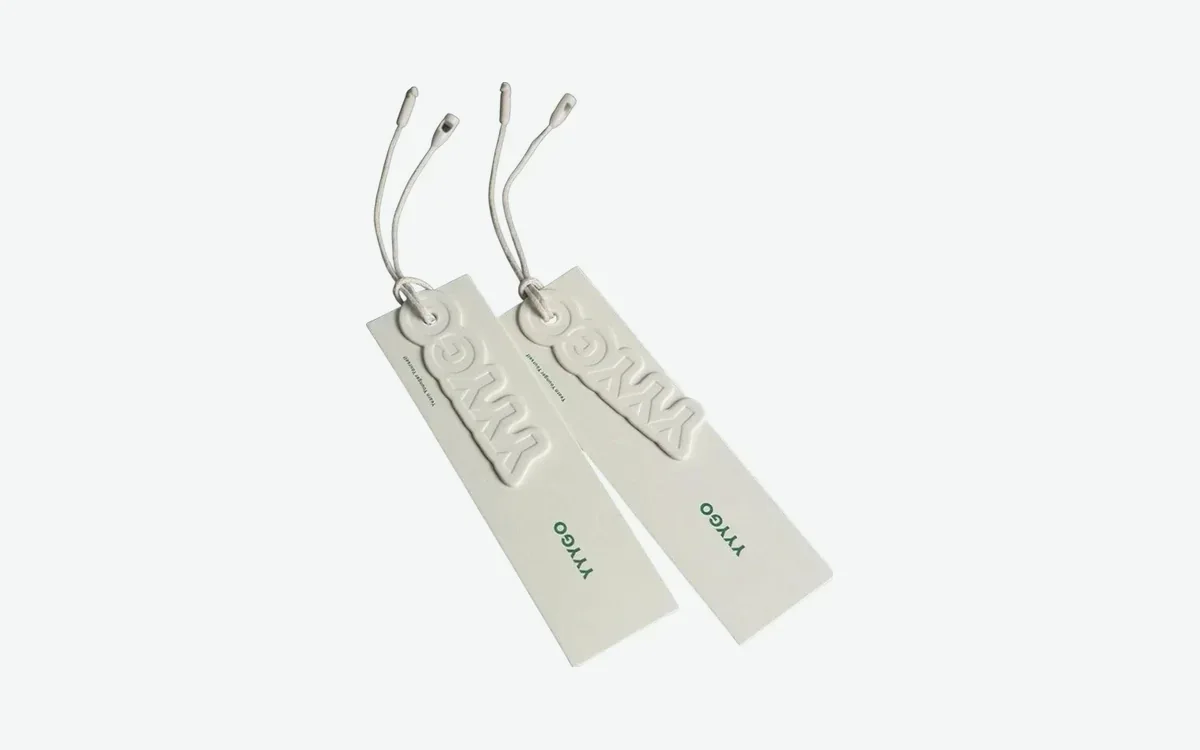
| Finished string loop | Typically 15–20 cm; shorter for small accessories, longer for thick outerwear seams |
| Reinforcement | Metal eyelet for heavy, layered or frequently handled tags |
Keep logos and text out of the hole zone, and choose a heavier board if the tag will be handled often. An eyelet in a colour that echoes your buttons or rivets turns a functional detail into part of the design. More on board weights and formats is on our hang tags page.
Saving time on the packing line
- Order tags ready to fit. We can supply them with the cord already threaded and knotted, or with the seal fitted.
- Pack by style and size. Bundles labelled per variant prevent mix-ups on busy days.
- Coordinate sizes and barcodes. If tags carry variable data, have them sorted and order the matching size labels at the same time.
- Run a trial. Tag one piece of each fabric, fold and pack it as it will ship, then unpack and inspect.
- Protect light fabrics. Keep metal parts away from pale materials in humid storage, and prefer label loops or fine needles.
Because tags, cords, seals and pins come out of our own production in Bulgaria, the complete set is matched and arrives in one delivery. Minimums usually start at 1,000 pieces per design, and production typically takes 10–20 working days after proof approval. Tell us what you are tagging at [email protected] or via WhatsApp/Viber on +359 876 766 050, and we will propose a complete set.
Frequently asked questions
Which hang tag fastener is kindest to delicate fabrics?
An elastic loop or a cord tied through a buttonhole or the sewn-in label leaves no mark at all. If you need a tagging gun, use a fine needle with fine pins and shoot through a seam rather than the face fabric.
How big should the hole in a swing tag be?
Around 4–5 mm works for most cords, elastic loops and pins. Thick cord, ribbon or a seal may need 5–6 mm. Keep the hole at least 5 mm from the edge.
What length of string loop looks right?
A finished loop of about 15–20 cm suits most garments. Accessories look better with a shorter loop; heavy coats may need a longer one.
Can you deliver tags with the string already attached?
Yes. As the manufacturer we can pre-thread and knot the cord or fit the seal, so your team only fixes the tag to the garment.
Are branded seals possible?
Yes, seals can be embossed or printed with your logo and produced together with your tags.