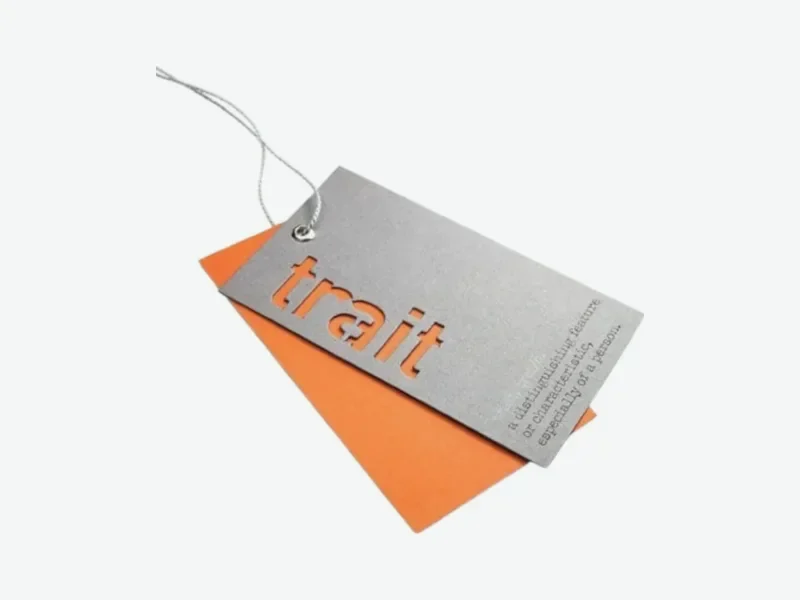
Put the same printed swing tag on a shiny nylon cord and on waxed cotton, and the second one simply feels finished. The string and fastener shape how the tag hangs, how fast your team attaches it and how the product is perceived.
As the manufacturer of the tags themselves, we supply strings, seals and pins as part of one set, matched in colour and cut to length. This guide covers the specifications to decide on.
Choosing a cord material
Cotton
Soft, matt and available in many colours. Twisted cotton has a rope-like character and knots firmly; braided cotton cord is rounder and smoother. Around 1–2 mm suits fine garments, 2–3 mm suits denim, outerwear and bags. Undyed natural cotton pairs well with kraft and recycled board.
Waxed cotton
A light wax coating makes the cord firmer and smoother. It holds its shape, ties a neat knot, does not fluff and threads quickly through holes – a real help on a busy packing table. It reads as crafted and fits leather goods, denim and premium casual lines.
Ribbons
Satin ribbon, usually 3–6 mm wide, brings a soft gloss to lingerie, eveningwear and gift items. Grosgrain is ribbed, matt and more structured. Both can be printed with your logo. Ends should be heat-sealed or cut on the diagonal to prevent fraying. For woven logo ribbons, see our woven tapes and ribbons.
Natural twines
Jute, hemp and paper twine give a rustic, handmade texture that suits kraft board and natural-fibre collections. Paper twine keeps the entire tag paper-based. Expect less uniformity than cotton – which is often the point.
Elastic
A pre-knotted elastic loop, typically 1–1.5 mm round, slips over a button or through a buttonhole. No tying, no marks, and it can be reused through sampling and photo shoots.
Polyester, nylon and metallic
Polyester and nylon cords are strong and colourfast, ideal for sportswear, outdoor and swimwear. Recycled polyester with GRS-certified material is available on request. Metallic gold or silver cords lift limited editions and festive ranges.
| Cord | Character | Typical size | Natural fit |
|---|---|---|---|
| Twisted or braided cotton | Soft, matt | 1–3 mm | Most garments, denim, knitwear |
| Waxed cotton | Firm, smooth | 1–2 mm | Denim, leather goods, premium casual |
| Satin ribbon | Glossy, soft | 3–6 mm wide | Lingerie, eveningwear, gifts |
| Grosgrain ribbon | Ribbed, structured | 3–10 mm wide | Premium tags, printed logo ribbon |
| Jute, hemp, paper twine | Rustic | 1–3 mm | Eco lines, kraft tags |
| Elastic loop | Stretchy, neat | 1–1.5 mm | Buttoned shirts and cardigans |
| Polyester or nylon | Strong, slight sheen | 1–2 mm | Sport, outdoor, swimwear |
| Metallic | Shiny | 1–2 mm | Limited and festive editions |
How the loop is closed
- Knotted loop – simple and natural.
- Pre-threaded – delivered already through the tag and knotted, so staff only loop it onto the garment.
- Stopper or bead – a small plastic, wooden or metal bead holds the loop and allows slight adjustment.
- Barb end – a pointed plastic tip passes through a buttonhole and locks into the loop at the other end.
- Seal – a plastic seal closes the loop permanently; it opens only by cutting.
Loops are typically 15–20 cm before closing; shorter for accessories, longer for thick seams and heavy coats.
Seal tags
Seals give every tag the same hanging length, cannot be untied and make it easy to see whether a returned item still has its original tag.
- Two-part snap seals: male and female discs click together around the cord, with room for an embossed or printed logo.
- One-piece seals: seal and pin moulded as one part.
- Colours: black, white and clear as standard; matched colours for larger quantities.
- Shapes: round, oval, square or custom.
Pins and plastic fasteners
Snap lock pins pass through the fabric or label and the tag, then lock into their own head. No string, no tool, removed by cutting – tidy on jeans, jackets and bags.
Safety pins fix a tag precisely through a seam or label and suit delicate fabrics and small runs. Our metal parts are nickel-free, in silver tone, gold, black and other finishes.
Plastic tag pins applied with a tagging gun are the fastest option for high volumes. Standard and fine versions must match the gun and needle. Lengths range from about 15 mm for a short fix to 50–75 mm for a free-hanging tag or bundles.
| Fastener | Tool | Removal | Typical use |
|---|---|---|---|
| Seal with cord | None, or a sealing tool for volume | Cut the cord | Premium lines, high-return categories |
| Snap lock pin | None | Cut | Jeans, jackets, bags |
| Safety pin | None | Open | Delicate fabrics, small runs |
| Tag pin, standard | Tagging gun | Cut | Medium and heavy fabrics |
| Tag pin, fine | Tagging gun, fine needle | Cut | Jersey and thin knits |
A quick decision path
- Brand look: crafted points to cotton, waxed cotton or jute; elegant to satin; technical to polyester and a neat seal.
- Line speed: high volumes favour pre-threaded cords, seals or tagging guns.
- Fabric: delicate fabrics call for buttonholes, labels, elastic loops or fine pins.
- Returns: a seal or lock pin shows if a tag has been removed.
Order the tag, cord and fastener together and they arrive as a ready-to-use set. Tell us about your product and packing process at [email protected] or WhatsApp/Viber +359 876 766 050, and see our hang tags for board and shape options.
How long should a swing tag string be?
Typically 15–20 cm before knotting or sealing. Use shorter loops for accessories and longer ones for thick seams or heavy outerwear.
What is the advantage of a seal tag?
Every tag hangs at the same length, the loop cannot be untied, and it is easy to see whether a returned item still carries its original tag.
Which fastener is fastest on a production line?
Plastic tag pins applied with a tagging gun. Pre-threaded strings also save a lot of time.
Can the string carry our logo?
Yes. Satin and grosgrain ribbons can be printed with a logo or brand name, and seals can be embossed.