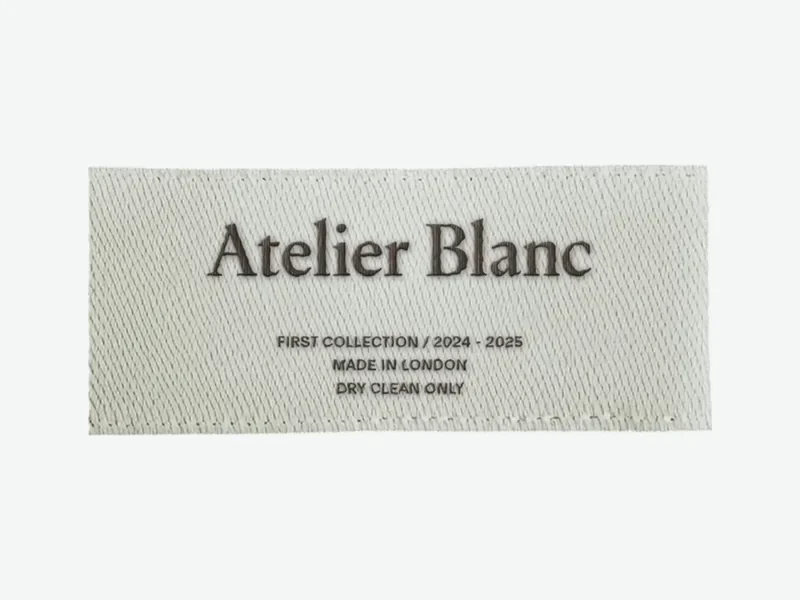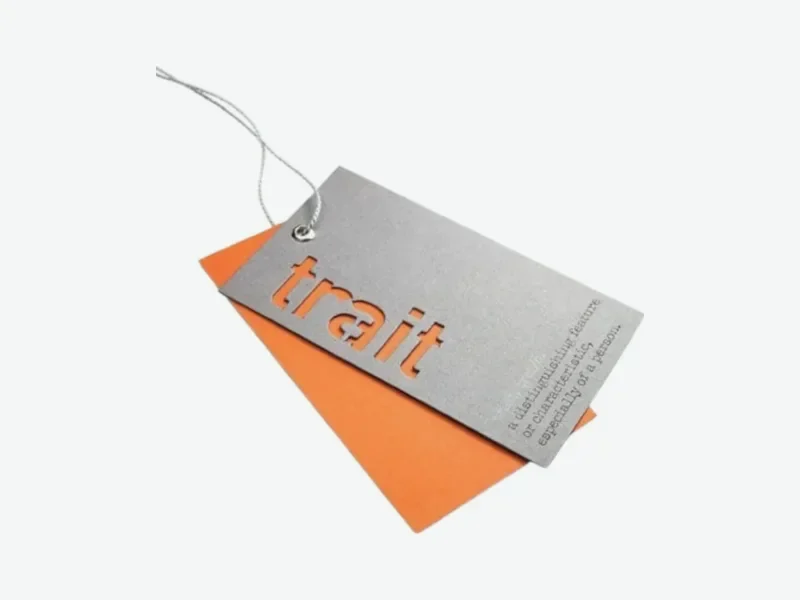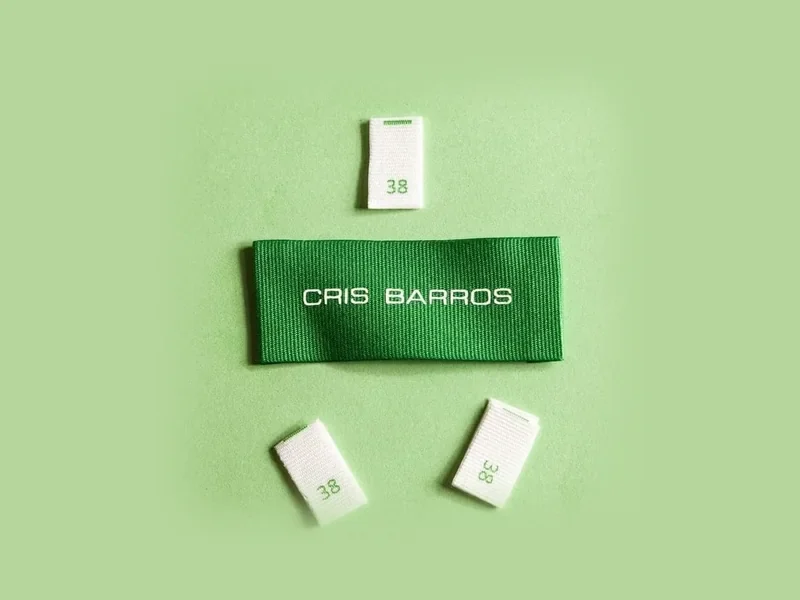
How big should a clothing label be? There is no legal answer for brand labels in the EU, which gives you freedom – and room for mistakes. This article sets out the reasoning we use as a label manufacturer when we recommend dimensions to a brand.
Picture three labels that went wrong: a neck label on a ribbed T-shirt that sticks out past the collar and itches; a care label so cramped that five languages are printed in microscopic type; a heavy leather patch dwarfing a child’s pocket. Each problem comes from choosing a size in isolation. Good label dimensions come from the garment, the label technique and the content working together.
Three questions that fix the size
1. Where does the label sit?
- Back neck – the most visible and most skin-sensitive spot. Keep the label shorter than the neck tape is wide so it does not curl or rub.
- Side seam – home of care, composition and size information. Length is flexible because it hangs inside, but width must suit the seam allowance.
- Outside hem – a small branded flag, usually loop- or end-folded so it lies flat.
- Back waistband – a wider, flatter area, but stretch waistbands need a soft label that does not stiffen the elastic.
- Pocket, cuff and yoke – decorative, seen from outside, and sized in proportion to the panel they sit on.
2. Which technique will you use?
Woven labels are durable and work well at neck and hem. Printed labels carry long multilingual text economically. Silicone, leather and metal labels are thicker and belong on outer positions. Patches are naturally larger. If you are still deciding on the technique, settle that first – it narrows the realistic size range.
3. What must the label say?
A logo alone needs far less area than fibre content, care symbols and several languages. Count the text before you choose the width, not after.
Finished size versus cut size
This is the single most frequent misunderstanding in label briefs. A centre-fold label shows only half of its cut length once folded. An end-fold label loses a few millimetres at each end inside the seam. When you brief us, always give the finished, visible size; as the manufacturer we calculate the cut length and seam allowance for the fold you choose. Our guide to label folds shows how each fold changes the visible area.
Starting dimensions by garment
Use these as a first draft, then adjust to your logo and fabric. Custom sizes are always possible; the full reference tables are on our label size guide.
| Garment and position | Suggested label | Finished size (mm) |
|---|---|---|
| Baby bodysuit, neck | Printed satin or heat transfer | 10–15 × 30–40 |
| T-shirt, neck | Woven damask, end- or centre-fold, or tagless transfer | 15–20 × 40–50 |
| Shirt or blouse, neck | Woven damask, end-fold | 15–20 × 40–50 |
| Hoodie or sweatshirt, neck | Woven damask or satin, end-fold | 20–25 × 50–60 |
| Coat or jacket, inside | Woven, flat or mitre-fold | 25–35 × 60–80 |
| Side seam care label | Printed satin or cotton tape, centre-fold or booklet | 25–40 × 40–100 |
| Hem flag | Woven, loop-fold | 10–15 × 15–25 |
| Beanie or cap | Woven or silicone, flat | 20–30 × 40–60 |
| Jeans, back waistband | Leather or faux leather patch | 70 × 50 to 90 × 60 |
Balancing logo and label
A label tends to look right when the logo occupies roughly 60–75 % of the usable width, with a clear margin of at least 2–3 mm from cut edges and folds. Anything closer may vanish into the stitching. Logo shape matters too: a long wordmark suits a wide, low label, while a stacked monogram suits a squarer one. If your logo is very wide, lengthen the label rather than shrinking the logo until it can no longer be read.
A quick reality check: print the artwork at 100 %, trim it to the finished size and pin it into a sample garment. Thirty seconds of looking tells you more about proportion and comfort than any screen.
Legibility limits
Every production method has a minimum text height. As a guide, keep capital letters at about 2 mm or more on woven labels and about 1.5 mm or more on printed labels, with bolder strokes for light text on a dark ground. If multilingual care label text does not fit at that size, move to a wider tape or a booklet label instead of reducing the type.
A quick self-check before you brief us
- Does the neck label stay within the collar band?
- Is the material soft enough for its position, especially on babywear and sportswear?
- Have you stated the finished size, not the cut size?
- Are sizes, URLs and care text above the minimum height?
- Have you scaled labels per garment type rather than using one size everywhere?
- Are the size labels planned to fit the same seam as the main label?
Our design team checks every one of these points on the digital proof, and for new designs we recommend a physical sample before production. Send a photo or tech pack to [email protected] and we will suggest a format for each garment.
Frequently asked questions
What is a typical size for a T-shirt neck label?
Most neck labels on T-shirts are around 15–20 mm wide and 40–50 mm long once folded. A tagless heat transfer is an alternative for maximum comfort.
Do I have to follow a regulated size?
No. EU rules govern what certain labels must say, not how big a brand label is. Size follows placement, technique and content.
Why did my folded labels turn out shorter than expected?
Usually because the cut size was given instead of the finished size. Tell us the visible size after folding and we calculate the rest.
How can I make a neck label less scratchy?
Keep it shorter than the collar band, choose fine damask or satin, ask for ultrasonically cut edges, or switch to a printed transfer.
Can you recommend sizes from a tech pack?
Yes. As the manufacturer we review your tech pack or photos and propose dimensions, then confirm them on a digital proof.