Describing a label in words is surprisingly hard. “Soft, quite thin, maybe folded” means something different to every reader. A label catalogue turns that guesswork into precise references – if you know how to use it. Here is how to read a manufacturer’s catalogue and turn it into a brief that gets an accurate quotation first time.
When a brand writes to us with a page number and a sentence such as “this construction, our logo, 20 mm wide”, we can usually quote in one reply. When the brief is a description alone, it often takes three or four emails to establish the same facts. A catalogue gives designer and clothing label manufacturer the same visual vocabulary, which saves time on both sides.
Inspiration or specification?
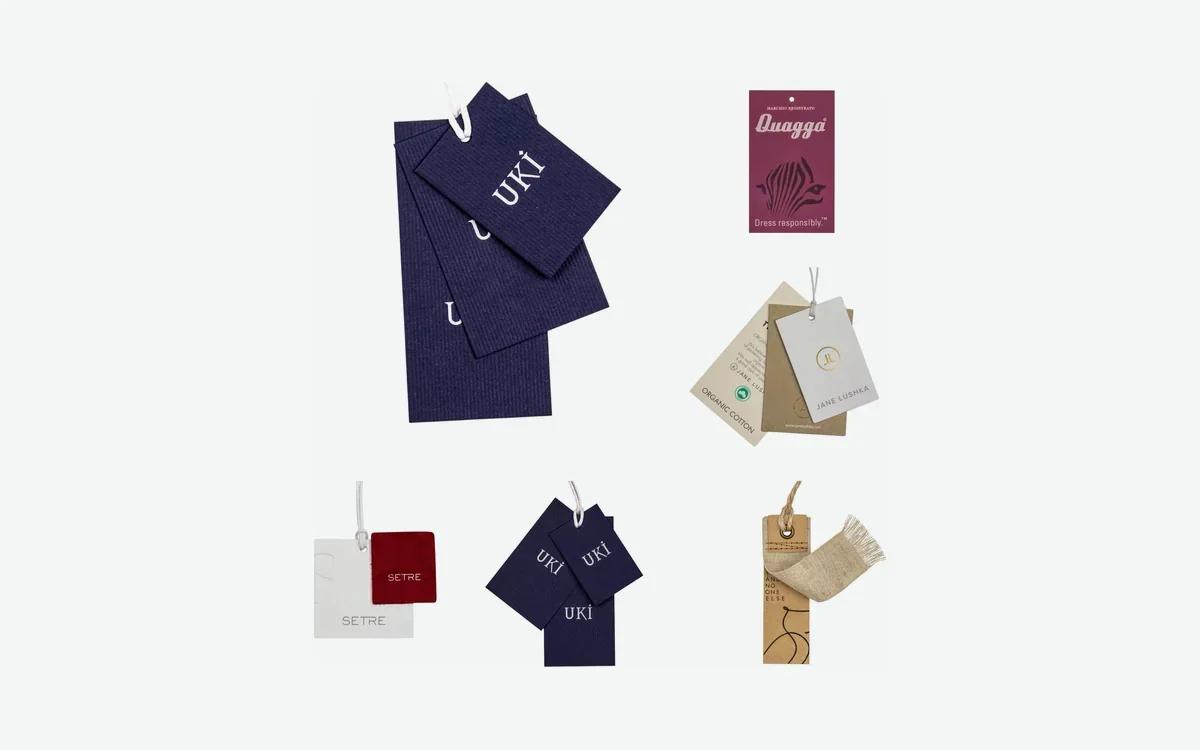
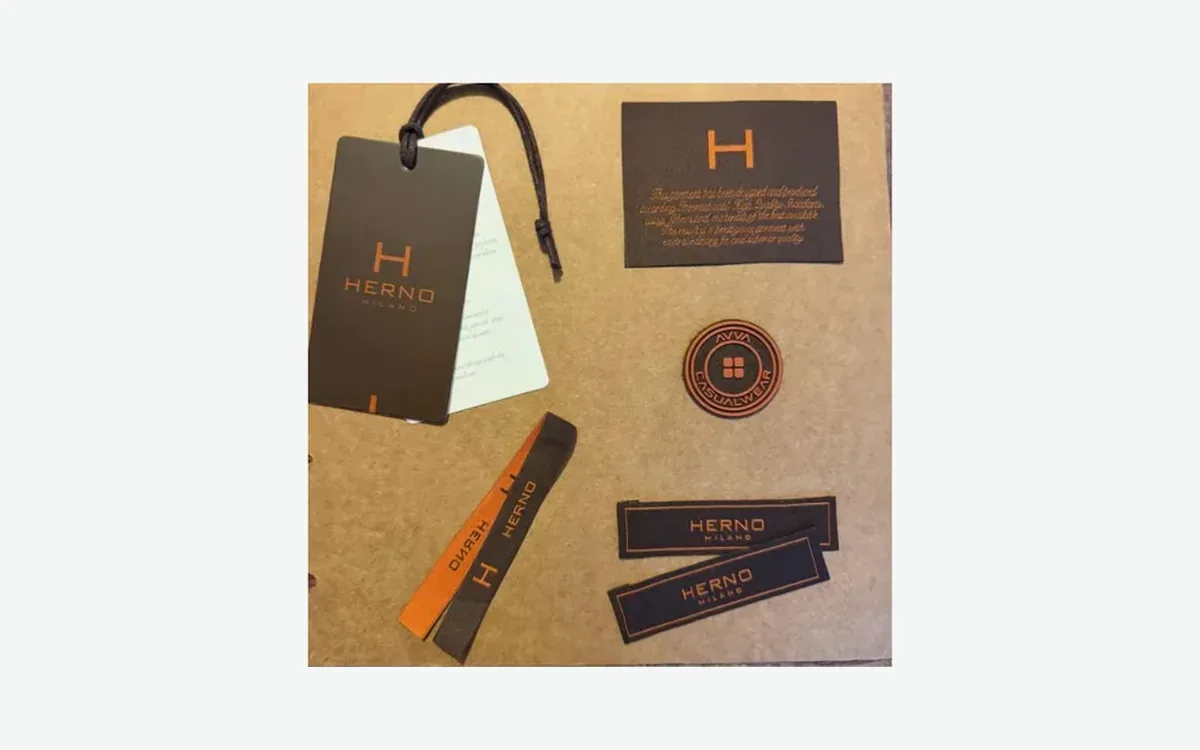
Some catalogues are essentially mood books – styled garments and lifestyle photography. They are pleasant to browse but hard to order from. A working catalogue goes further. When you open one, check whether it includes:
- clearly separated product families – woven, printed, care and size labels, hang tags, silicone, leather and metal labels, patches, heat transfers, stickers;
- named materials and qualities, such as damask, satin or taffeta for woven labels, satin, cotton or Tyvek for printed ones, and board weights for tags;
- finishing details – ultrasonic, laser or heat-cut edges, coatings, iron-on or adhesive backs, embossing, foil, softening;
- folds shown both flat and sewn;
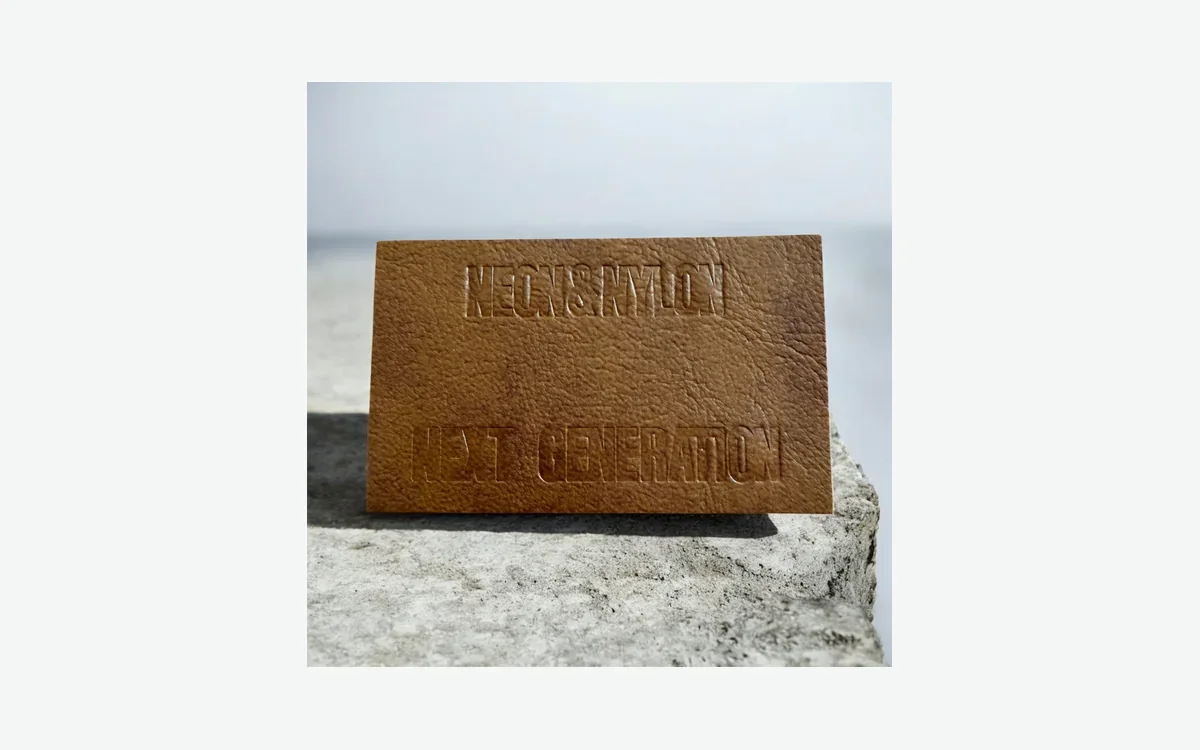
- close-up photos of real produced pieces, sharp enough to judge texture, edge and colour;
- page numbers or item codes you can quote.
If those elements are there, the catalogue is a specification tool, not just a picture book.
Writing a reference that cannot be misread
A strong catalogue reference answers four questions: which item (catalogue, page and position), what to keep (the whole label, or only the material, fold, edge or colour scheme), what to change (logo, colours, dimensions) and how many, by when. Minimums usually start at 1,000 pieces per design.
| Loose request | Precise reference |
|---|---|
| “A classy label for our knitwear” | “Labels 2026, page [n], centre: same satin-finish damask and mitre-fold; our logo in gold on bottle green; 25 × 60 mm finished” |
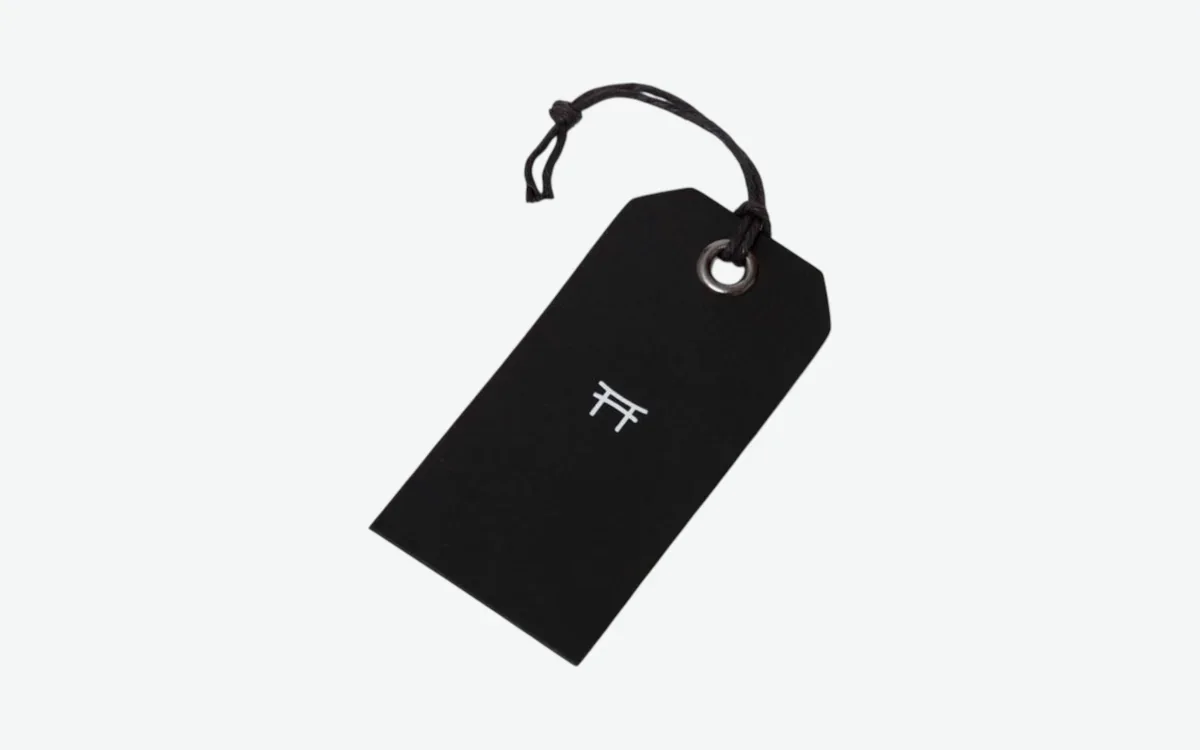
| “Kraft tags with string” | “Labels 2026, page [n], bottom right: same kraft board and jute cord; our artwork; 55 × 85 mm; rounded corners” |
| “A rubber logo for caps” | “Labels 2026, page [n], top: same 3D silicone build and texture; our logo in two colours; 40 × 25 mm” |
Busy pages can show eight similar labels side by side, so add a screenshot with a circle around the one you mean. It takes ten seconds and removes all doubt.
Mixing and matching references
You are not limited to items exactly as shown. Take the yarn quality from one page, the fold from another and the colour treatment from a third. We check at proof stage that the combination is technically sound, then build it with your artwork. Equally, the dimensions printed in a catalogue are examples – every size can be adjusted. Our label dimensions guide and the size reference tables help you choose.
Screen, paper and the real thing
| Format | Strengths | Limits | Best moment to use it |
|---|---|---|---|
| PDF catalogue | Instant, free, shareable, searchable by page | Screens distort colour; no hand feel | Early research and shortlisting |
| Digital proof of your design | Shows your label at true scale with dimensions and fold | Still a drawing | After choosing construction |
| Physical sample of your design | True softness, thickness, edge and colour against your fabric | Takes time to make and ship | Before bulk production of new labels |
We suggest working through the three in that order. Use the PDF to narrow down, approve a digital proof, then request a physical sample wherever softness or a precise colour matters. Always add Pantone references: printed colours in a PDF will never match yarn or ink exactly. The full order sequence is described in our ordering guide.
About our Labels 2026 catalogue
Our Labels 2026 catalogue runs to 28 pages, and every piece in it was produced on our own equipment in Bulgaria – woven and printed labels, care and size labels, hang tags, silicone, leather and metal labels, patches and more. That matters for you: as the manufacturer, anything shown is something we can reproduce in your artwork, sizes and colours. Request the free PDF at [email protected]. Themed catalogues are in preparation for woven labels, hang tags, care and size labels, and silicone, leather and metal labels.
Pitfalls to avoid
- Describing an item in words when several similar ones share the page.
- Treating the size shown as fixed.
- Relying on on-screen colour instead of Pantone numbers.
- Not stating whether a reference covers the whole label or one feature.
- Sending a reference without artwork – the catalogue shows how to make it, your files show what goes on it.
If your logo needs adapting to the chosen construction, for example simplifying hairlines for weaving, our design team prepares a digital proof, typically within 24–48 hours.
Frequently asked questions
How do I get your label catalogue?
Email [email protected] or message us on WhatsApp/Viber at +359 876 766 050 and we will send the Labels 2026 PDF free of charge.
Will my label look exactly like the catalogue example?
The construction, material and finish will match; the logo, colours and size will be yours, confirmed on a digital proof.
Can I combine features from different pages?
Yes. We check the combination at proof stage and produce it if it is technically sound.
Is a PDF enough to judge softness?
Not really. For skin-contact labels we recommend a physical sample of your design before production.