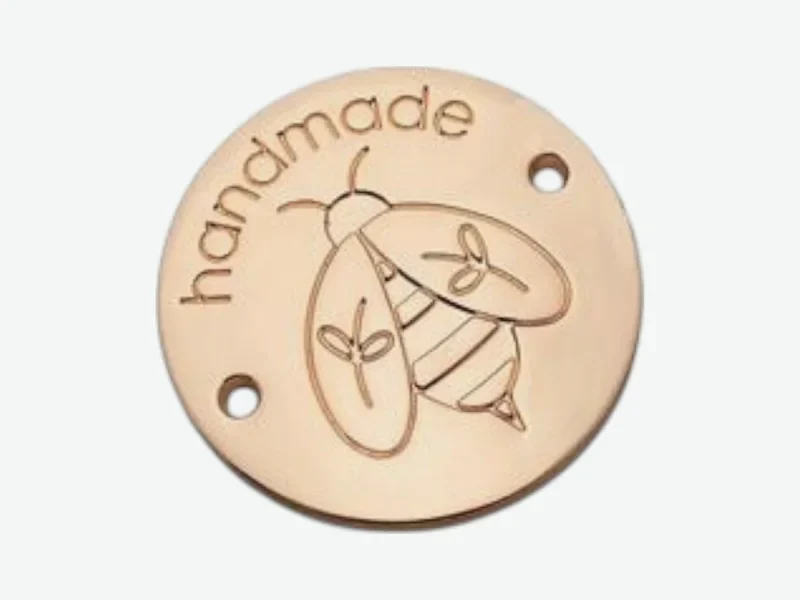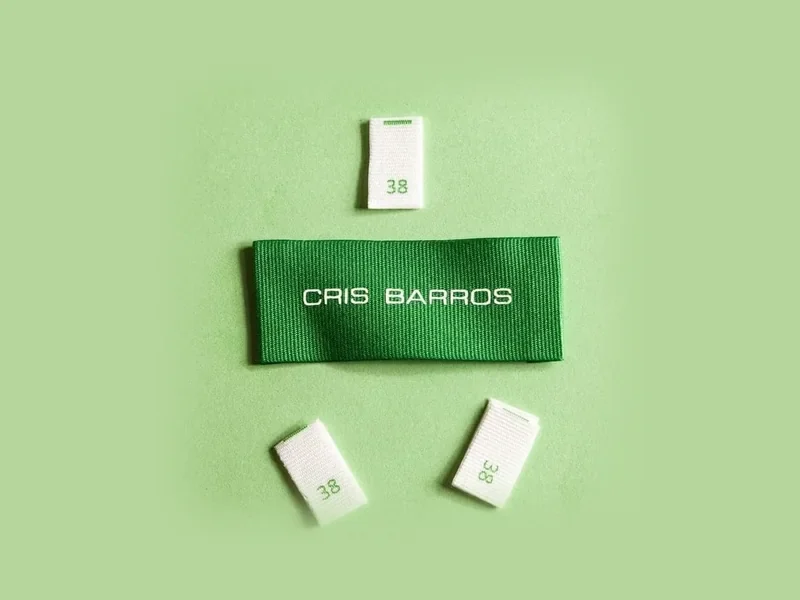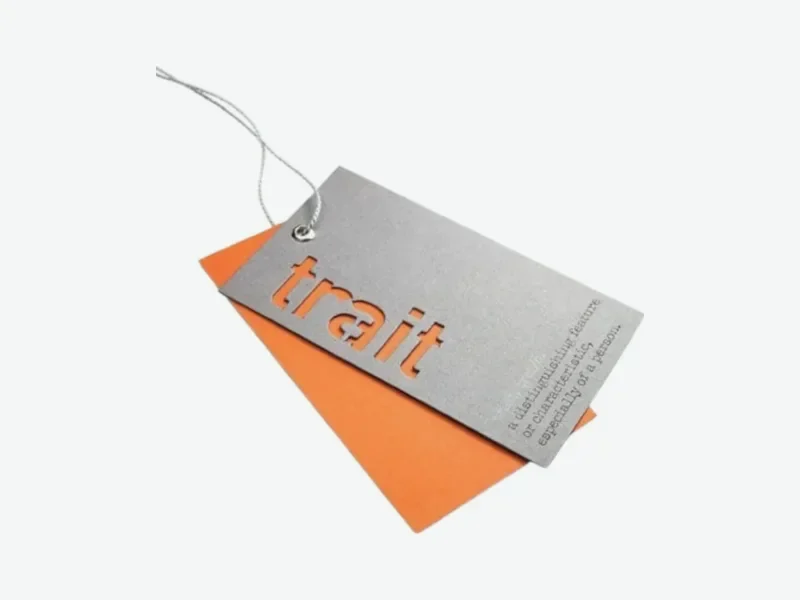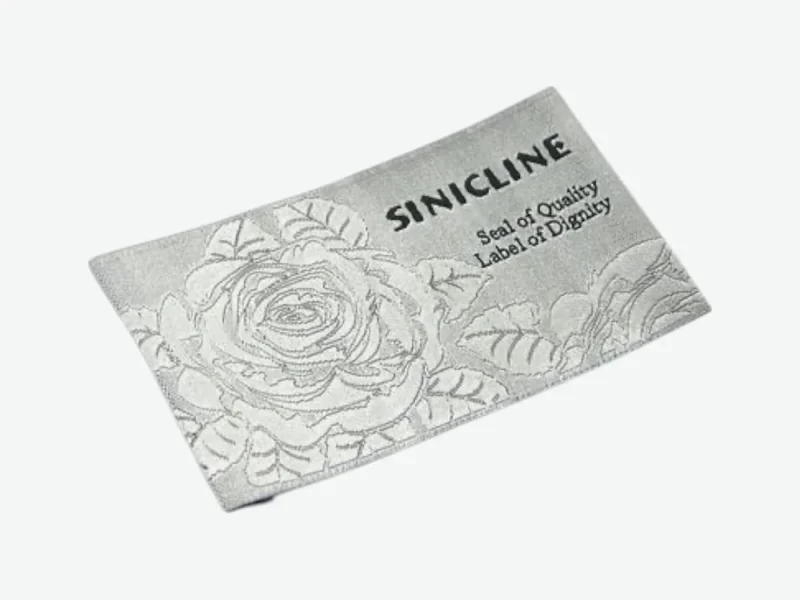
A brand mark is usually designed for a screen, a shop sign or a shopping bag. A neck label gives it perhaps 40 by 15 millimetres of fabric, built from thread or ink. Our design studio exists to bridge that gap, so the label still looks unmistakably like your brand when it is the size of a postage stamp.
Because we are the manufacturer, our designers sit next to the looms, printers and moulds that will make your order. They prepare artwork with those machines in mind, which is why most designs pass from first file to approved proof in a short, predictable loop.
The five questions every artwork has to answer
1. Is it a clean vector?
Looms, printing plates and silicone moulds are all driven by vector paths. A JPG from a website, a photo of an old label or a PDF with embedded pixels has to be redrawn first. The designer traces the mark, straightens wobbly curves and converts every font to outlines, so nothing shifts when the file opens elsewhere.
2. Will the details survive the reduction?
Hairline serifs, delicate script and tight tracking tend to vanish at label scale. We thicken thin strokes, open up the small enclosed spaces inside letters such as e, a and g, and sometimes suggest a simplified “label version” of the logo. Many brands keep that version for all future trims.
3. Is the text large enough for the technique?
Woven letters are made of yarn, so they cannot be finer than the thread itself. Print holds finer detail. As a guide:
| Technique | Capital height, typical minimum | Line weight, typical minimum |
|---|---|---|
| Damask weave | about 1.5–2 mm | about 0.3–0.4 mm |
| Taffeta weave | about 2–2.5 mm | about 0.4–0.5 mm |
| Print on satin or cotton | about 1.2–1.5 mm | about 0.2 mm |
| Silicone or rubber | about 2–3 mm | about 0.5 mm |
Font, weave density and material move these limits a little. Anything at risk is flagged before you see the proof.
4. How many colours does it really need?
A woven label combines a base warp with a limited set of weft colours; two to four is the sweet spot. Shadows, gradients and photographic effects cannot be woven as they appear on screen. If a gradient is central to the design, we will suggest printed labels or heat transfer labels, which reproduce it far better.
5. Does the colour match?
Screens vary, so we work from Pantone references. For woven labels the designer picks the nearest yarn shade from our range; for print, inks are mixed towards the reference. Thread on fabric never looks identical to ink on a paper swatch, which is why colour-critical brands often request a physical sample.
Legibility is about contrast, too
A size letter in mid-grey on a light-grey ground is hard to read even when it is large. Strong contrast, a sensible font weight and adequate spacing matter as much as point size. Our designers check every proof at actual size and adjust weight or spacing where URLs, sizes or small print start to blur.
Care labels: the densest layout
A care label combines fibre composition, the five care symbols in their fixed order and often several languages. The designer groups this content into clear blocks, keeps the type legible, and recommends a booklet format once the text outgrows a single panel. See our care labels for formats.
What to send with your enquiry
- The logo as AI, EPS, PDF or SVG. If all you have is an image, send the highest resolution available.
- The label type and rough size, or simply the garment and where the label goes.
- Pantone references, or a fabric swatch you want matched.
- Fold or finish if known: straight cut, centre-fold, end-fold, iron-on backing.
- All wording, including sizes, composition and languages.
Not sure about dimensions? Our label size guide gives typical formats by position.
From proof to production
- Digital proof – typically within 24–48 hours, shown at actual size with dimensions, fold and colour references.
- Corrections – reply with all comments in one message; most designs are approved after one or two rounds.
- Physical sample – optional, recommended for new designs or demanding colours.
- Production – typically 10–20 working days after approval, then delivery across the EU.
A useful habit: print the proof at 100% and hold it against the garment. A zoomed screen view always flatters small text.
Typical fixes we make
- Files that pixelate when scaled to production size.
- Live fonts that change on another computer.
- More text than the label can hold at a readable size.
- Outlines too thin to weave cleanly.
- RGB-only colours with no Pantone reference.
- Text placed too close to a fold or cut edge, where the seam would swallow it.
Send your logo and a few words about the label to [email protected], or via WhatsApp or Viber on +359 876 766 050, and our studio will prepare your first proof.
How fast will I see a first proof?
Typically within 24–48 hours of receiving your logo and label details.
I only have a PNG of my logo. Is that enough?
Yes. Send the best resolution you have and our designers will redraw it as a vector file suitable for weaving, printing or moulding.
Can you weave a gradient?
Not as it appears on screen. We can reduce it to solid colour steps or recommend a printed or heat transfer label, which reproduce gradients well.
How many correction rounds are possible?
We revise until the proof is right. Most designs are approved after one or two rounds when all comments arrive together.
Will I keep a label version of my logo for future orders?
Yes. Approved artwork is stored, so repeat orders and new trims can use the same production-ready file.