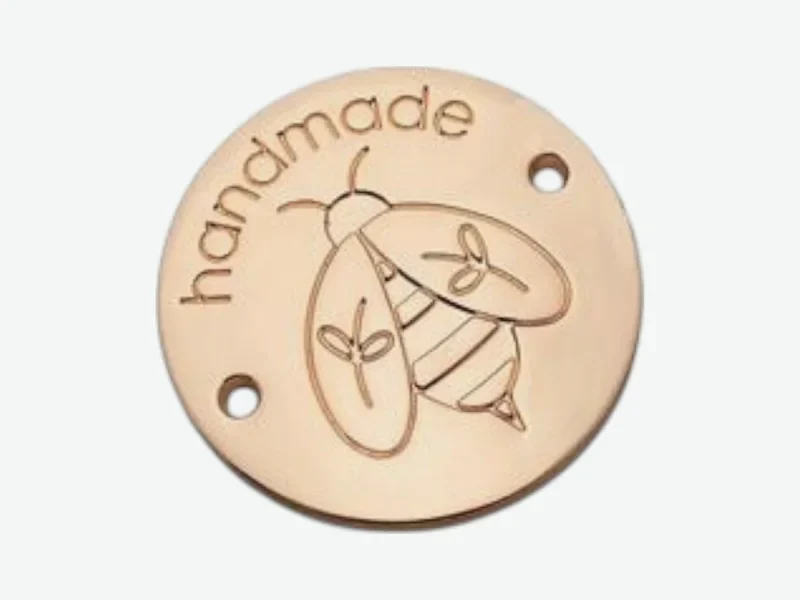
Customers rarely read a metal label; they touch it. They run a thumb over a waistband plate, notice the weight of a bag emblem or see a cap badge catch the light. That tactile moment is why metal works so well for brand identity.
We manufacture custom metal labels in our own production in Bulgaria, and every project comes down to three linked decisions: which metal, how the logo is formed, and how the label is fixed to the product. Get one wrong and the others suffer. Below, we go through them with real product examples.
Three example briefs
Before the theory, here is how the choices play out in practice.
- A heritage denim brand wanted a slim plate on the coin pocket. We suggested stamped brass with a debossed logo and an antique brass finish, fixed with two prongs over a backing plate.
- An outdoor label needed a badge on a rain shell that would face weather and abrasion. Laser-engraved stainless steel with sew-on holes was the robust answer.
- A bag designer asked for a sculpted emblem with two relief levels and an enamel accent. Die-cast zinc alloy with soft enamel and screw posts gave the depth and the firm hold.
Choosing the metal
| Metal | How it is made | Character | Typical home |
|---|---|---|---|
| Zinc alloy | Die-cast in a steel mould | 3D shapes, cut-outs, several relief heights; takes almost any plating | Bag emblems, outerwear badges, caps |
| Brass | Stamped from sheet | Warm colour, solid weight, crisp edge | Jeans and trouser plates, premium knitwear |
| Aluminium | Stamped or cut from sheet | Very light; anodised colours, print or laser | Caps, lightweight garments, knitwear |
| Stainless steel | Stamped or cut from sheet | Hard, highly corrosion-resistant | Workwear, outdoor gear, bags |
All of our metal labels are nickel-free. Where a finish is called “nickel”, it describes a colour look only.
Forming the logo
- Stamped relief: a hardened die raises or recesses the logo in sheet metal. Clean and long-lasting.
- Cast relief: the logo is part of the mould, so domed areas, textured backgrounds and several heights are possible.
- Laser engraving: fine text, small marks and serial numbers, and new variants without a new tool.
- Enamel: recessed areas filled with soft or hard enamel in colours matched to your Pantone references.
- Print under epoxy: full-colour artwork on a flat plate, protected by a clear dome.
- Cut-through: letters punched or cast right through the metal so the fabric shows, a striking effect on contrasting materials.
Keep raised or recessed lines above roughly 0.3–0.5 mm for casting and stamping; anything finer is better laser-engraved. Separate enamel colours with a thin metal wall.
Picking the finish
Plating defines the final colour: gold, light gold, rose gold, silver, nickel-look silver, gunmetal, black and copper are the most requested. Antique finishes such as antique brass, silver or copper darken the recesses to make relief stand out, a natural partner for denim. Surfaces can be high polish, matt, satin, brushed or sand-blasted, and two textures can share one plate, such as a matt field with a polished logo. A clear lacquer adds protection against abrasion and humidity.
One rule saves many collections: match the label to the hardware already on the product. A gold plate on a jacket with gunmetal zips and buttons looks as if it came from a different collection.
Fixing it to the product
| Fixing | How it works | Best on |
|---|---|---|
| Prongs | Two or four claws pushed through and bent flat, ideally over a backing plate | Denim, jackets, bags |
| Sew-on holes | Holes at ends or corners for stitching | Knitwear, waistbands, hats |
| Rivets | One or two permanent rivets | Denim, leather, heavy canvas |
| Screw posts | Threaded post with screw back | Leather goods, luggage |
| Adhesive | Strong double-sided layer | Boxes, hard goods, packaging |
On thin or stretchy fabric, add a backing plate or a small reinforcement behind prongs; it spreads the load and keeps the label straight after wear.
Typical dimensions
Slim plates of about 20 × 5 mm suit cuffs and knitwear. Plates of 30 × 8, 40 × 10 and 50 × 15 mm are common on waistbands, pockets and bags. Round emblems usually measure 15–25 mm across, shaped badges 25–40 mm. Thickness runs from about 0.5 mm for slim stamped plates to 1.5 mm or more for cast emblems. For proportions, see our label size guide.
Washing and wear
Well-plated labels handle normal laundering. Recommend washing inside out without chlorine bleach, and choose a protective lacquer for frequently washed items. If denim is stone- or enzyme-washed after the label is fitted, test the finish through that exact process, because abrasion can wear plating at the edges. Make sure the care label instructions suit the trim as well as the fabric.
From drawing to delivery
Send vector artwork with outlined fonts, mark where prongs, holes or rivets should go, and add a photo of the product. Our design team returns a dimensioned technical drawing and digital proof, typically within 24–48 hours. A physical sample follows so you can judge weight, finish and fixing on the real garment; after approval, production typically takes 10–20 working days, with delivery across the EU. Combine plates with our leather labels for a complete trim set, browse the metal labels range, or send us your logo.
Which metal is best for a label that faces rain and sweat?
Stainless steel is the most corrosion-resistant choice, with aluminium as a lighter alternative. Both take laser engraving very well.
Are your metal labels nickel-free?
Yes, every metal label we produce is nickel-free. “Nickel” in our finish list only names a silver colour tone.
Can I add colour to a metal logo?
Yes, with soft or hard enamel matched to Pantone references, or with full-colour print under a clear epoxy dome.
Will plating survive stone wash?
It can, but abrasive washes may wear edges. We recommend running a physical sample through your wash process before bulk production.