Underwear, bras and swimsuits are worn closer to the body than anything else in a wardrobe. Their labels get wet, stretched, pressed under straps and rinsed in chlorine or sea water. A label that goes unnoticed in a sweatshirt can scratch in a bikini top or show through a moulded cup. This guide explains how we, as the manufacturer, build soft labels for swimwear and intimates.
Know the enemies first
- Chlorine and salt fade weak dyes and loosen poorly sealed edges.
- Sweat and body oils can stiffen labels and blur print.
- Sun cream and UV stain pale labels and fade unsuitable inks.
- Elastane stretch means a rigid label restricts or puckers the seam.
- Pressure and thin fabrics make thick labels or hard edges both felt and seen.
The answer is always a combination: thin, colourfast materials, sealed soft edges and careful placement.
Placement decides comfort
We start with position because it has more influence on comfort than any material choice.
| Product | Recommended position | Keep away from |
|---|---|---|
| Bras | Side wing, or centre back near the hook-and-eye, sewn into the seam | Cups and the underwire channel |
| Briefs and thongs | Side seam or back waistband seam, small and flat – or printed inside | Front panel |
| Swimsuits and bikinis | Side seam of the bottom, inside the lining, or printed on the lining | Neckline and straps |
| Swim shorts | Outside badge on leg or waistband; care label in side seam or inner pocket | Inner thigh |
| Shapewear, seamless pieces | Tagless print inside | Any sewn label that would show through |
Composition information must be durable, legible and accessible. Even if some wearers remove labels, the label has to do its job at the point of sale – so make it comfortable enough that it stays in.
Materials for intimate and swim products
Soft printed satin
Polyester satin printed with a durable ink is the workhorse for lingerie care labels: smooth on both sides, thin, and good with tiny multilingual text. Specify a soft-hand quality and a print system tested for repeated washing. See printed labels.
Woven satin and high-definition damask
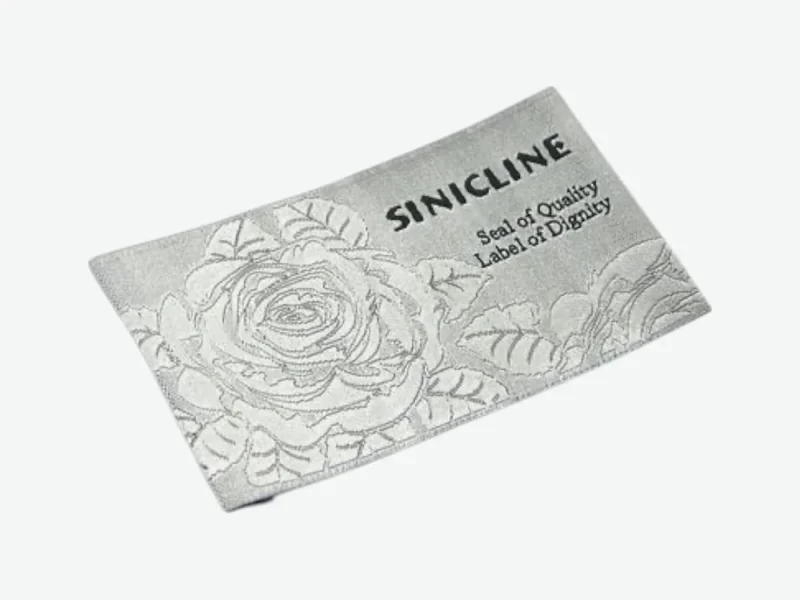
For the brand, a satin weave feels softer than taffeta, while high-definition damask keeps small lettering crisp. Because the colour is in the yarn, woven labels hold up very well in chlorine and salt water. Keep the design simple and the size small; a softening finish reduces the hand feel further.
Nylon taffeta
Very durable but crisper, so best for covered seams or lined sections where it does not touch skin directly.
Low-temperature heat transfers
Often the most comfortable label is none at all. A heat transfer printed on the lining carries logo, size and short care data and is barely felt. Transfers for stretch fabrics move with elastane without cracking; match them to the fabric and test them.
Small silicone badges
For the outside of swim shorts or on straps, a compact silicone badge is smooth and very water-resistant.
Edges, sizes and folds
The edge usually causes irritation, not the face. Ask for ultrasonic cutting, which seals fibres cleanly without the hard bead a hot knife can leave. Keep lingerie brand labels around 10–15 mm wide and care labels about 25–30 mm wide. A centre fold or loop fold sewn into a seam tucks the cut ends into the seam allowance, while a flat label stitched on all four sides cannot flip up. Avoid fused stiffeners on anything that touches skin. Sew a physical sample into a real garment before approving – folds behave differently in a stretch seam than on a desk.
What the care label should say
Under Regulation (EU) No 1007/2011, composition is given by weight with official fibre names, for example “78% polyamide, 22% elastane”. Lined swimsuits and padded bras often have several components – outer fabric, lining, padding – so list each one. Care symbols follow ISO 3758. Typical content includes a 30 °C delicate or hand wash (a laundry bag for bras), no bleach, no tumble drying, drying flat or in the shade, no ironing for moulded cups and elastane-rich fabrics, and for swimwear a line such as “rinse in cool fresh water after use”. With many markets, a booklet care label keeps long translations compact.
Colour and finish
Lingerie brands often want labels in nude tones, black, ivory or seasonal shades to match the fabric, matched to Pantone. Keep fine lines thick enough to stay legible after washing, and use metallic yarn for gold or silver lettering sparingly so the label stays soft. Imagine an ivory lace bralette with a 12 mm blush satin label and fine gold woven lettering: discreet, premium and comfortable.
Test like a customer
Sew a sample in, wear it, wash it ten times following your own care instructions and, for swimwear, rinse it in chlorinated water. Then check legibility, edge softness and any colour transfer to the fabric. OEKO-TEX certified materials are available for all next-to-skin products.
Ordering
Send us composition, care instructions, languages and photos of the garments with intended label positions. Our design team prepares a digital proof, typically within 24–48 hours, and physical samples follow for wear tests. Production typically takes 10–20 working days after approval in our own production in Bulgaria, with delivery across the EU. Minimums per design are low – ask us at [email protected] or WhatsApp/Viber +359 876 766 050.
Frequently asked questions
Where should a bra label be sewn?
On the side wing or at the centre back near the closure, caught in the seam – never in the cup or underwire channel.
Do woven labels survive chlorine?
Yes, very well. The colour is in the yarn rather than in a surface ink, so it holds up in pool and sea water.
How small can a lingerie label be?
Brand labels are often 10–15 mm wide. Care labels need a little more room, typically 25–30 mm wide.
Does a padded bra need composition for each part?
Yes. List outer fabric, lining and padding separately when they differ.
Are tagless prints suitable for swimsuits?
Yes, low-temperature transfers designed for stretch fabrics work well on swim linings. Test them on your exact fabric first.