Twenty kilometres into a long run, a label that felt fine in the changing room can rub the skin raw. Activewear asks more of a label than any everyday garment: stretch in every direction, salt and sweat, a wash after almost every use. Here is how we, as an activewear label manufacturer, choose between tagless prints, silicone logos, reflective details and soft sewn labels.
Inside versus outside
The simplest way to plan sportswear labelling is to split it in two. Inside the garment, the goal is to be invisible to the body – often by having no sewn label at all. Outside, the goal is a logo that looks technical and survives abrasion. Everything else follows from that split.
| Label | Inside or outside | How it is applied | Where it excels |
|---|---|---|---|
| Tagless heat transfer | Inside | Heat press | Neck of base layers, leggings, running tops |
| Soft printed label | Inside | Sewn into a seam | Multilingual care data, codes, wide size ranges |
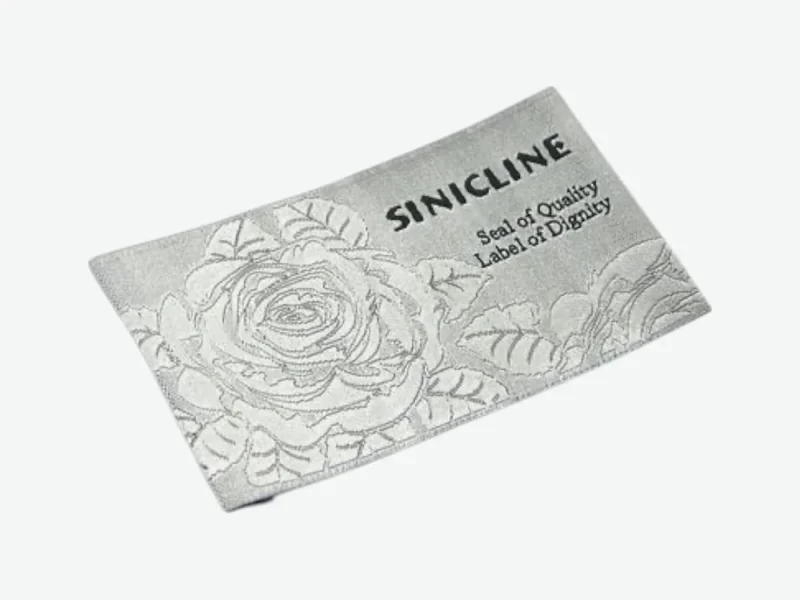
| Fine damask woven label | Inside | Sewn | Hoodies, track jackets, training trousers, bags |
| Silicone or TPU logo | Outside | Heat press or sewn | Chest, sleeve, hood, waistband |
| Reflective transfer | Outside | Heat press | Running, cycling, caps, packs |
Tagless prints: getting the transfer right
A heat transfer label is printed on a carrier and pressed into the fabric, so it has no edge and no seam. For compression tights, sports bras and base layers it is the standard neck solution for logo, size and care. Three technical points decide success:
- Elastic ink that stretches with elastane instead of cracking.
- Low application temperature and short press times for thin synthetics and coated fabrics.
- Dye migration blocking. On dyed or sublimated polyester, dye can travel into a pale transfer during pressing and tint it. A blocker layer keeps a white logo white on a red cycling jersey.
Silicone logos for the outside
A raised 2D or 3D silicone label on a chest or sleeve reads as performance gear at a glance. Silicone and TPU stay soft, resist sweat, washing and abrasion, and remain flexible in cold weather – useful for winter running and cycling. Heat-applied versions suit stretch fabrics because there are no needle holes; sew-on badges with a stitching border are more common on heavier jackets and kit bags. Colours are matched to Pantone, and matt-gloss contrasts or fine textures can be moulded into the surface.
Reflective details
Reflective transfers contain glass beads or microprisms that return light to its source. In daylight a logo looks silver-grey or printed in colour; in headlights it lights up. On a winter running jacket, a reflective logo on the back and a small segmented stripe on the sleeve combine branding with better visibility. Segmented designs bend more easily on moving zones such as elbows and calves. A reflective logo is a design and visibility feature; garments that must meet high-visibility standards need certified materials and testing by the garment maker.
When a sewn label still makes sense
Long multilingual care text, a production code or an extended size range are easier on a sewn label. A printed label on satin or soft polyester tape with wash-resistant ink is smooth and light, and ultrasonic edges stay soft. For hoodies and track tops, a fine damask woven label with a fold that hides the cut ends works well.
Placement rules for moving bodies
- Neck: print, do not sew, on base layers and compression tops.
- Care label: low in the left side seam, where the garment moves least against the skin; on leggings, the inner waistband seam or just below it.
- Flatlock seams: a label caught in a flatlock creates a hard spot – use a separate soft seam or a print.
- Pressure points: keep clear of shoulders under backpack straps, the lower back under a hip belt and the inner thigh.
- High-stretch areas: keep transfers modest in size and avoid large solid areas.
Before bulk, wear-test a sample with the final labels for a full session and a few washes. Real training reveals friction and adhesion issues faster than any desk inspection.
Care content that matches the trims
Technical fabrics often need lower wash temperatures, no fabric softener – it can block moisture transport – and no hot tumble drying or ironing. Fibre composition is mandatory under Regulation (EU) No 1007/2011. Make sure the care label reflects the most sensitive component: if a transfer is rated for 40 °C, the label should not allow a hotter wash.
Recycled and certified options
If your collection uses recycled polyester, your labels can too: recycled tapes and yarns with GRS certification are available for printed and woven labels. OEKO-TEX certified materials are available for products worn against the skin during exercise.
What to send us
Describe each garment, its fabric composition and any coating; tell us where each label goes and how it will be applied; and send a vector logo with care and size data. As the manufacturer, we return a digital proof, typically within 24–48 hours, and physical samples to test on your fabric. Production typically takes 10–20 working days after approval, with delivery across the EU. Minimums per design are low – ask us at [email protected] or on WhatsApp/Viber +359 876 766 050.
Frequently asked questions
Why do light logos sometimes turn pink on polyester kit?
That is dye migration: dye from the fabric moves into the transfer during pressing. A transfer with a blocker layer prevents it.
Heat-pressed or sewn silicone – which should I choose?
Heat-pressed suits stretch fabrics because there are no needle holes; sewn badges suit heavier jackets and bags.
Is a reflective logo enough for high-visibility clothing?
No. It improves visibility as a design element, but certified high-visibility garments require certified materials and testing.
Where should the care label sit in leggings?
In the inner waistband seam or the side seam just below the waistband, away from pressure points.
Can sportswear labels be made from recycled polyester?
Yes, GRS-certified recycled options are available for both printed and woven labels.