Before a jacket reaches a shop floor in Lisbon, Lyon or Lódź, the small label in its side seam has to carry information that European law defines quite precisely. This briefing sorts that information into three groups: what is compulsory, what retailers will expect anyway, and what simply saves you trouble later.
As a clothing label manufacturer we check these points at every proof. Treat them as general guidance, not legal advice.
Step one: know which regulation applies
Fibre labelling in the EU is governed by Regulation (EU) No 1007/2011. Because it is a regulation rather than a directive, the same text applies directly in every member state. It covers products made of at least 80% textile fibres by weight, plus certain items with a textile part, such as furniture covers or umbrella canopies.
Annex V lists exempt items and Annex VI products that may share one inclusive label; check them for borderline products.
Step two: write the composition correctly
The composition line is where most corrections happen. The essentials:
- Use only the fibre names listed in Annex I of the regulation, for example cotton, wool, viscose, polyamide, polyester or elastane. A fibre trade name may appear next to the official name, never in place of it.
- Give percentages by weight in descending order: 78% cotton, 20% polyamide, 2% elastane.
- A single-fibre product may be called 100%, pure or all, with a small allowance for technically unavoidable extraneous fibres.
- Fibres of up to 5% each, or up to 15% together, can in some cases be grouped as “other fibres”.
- Visible, separable decorative fibres up to 7% and antistatic fibres up to 2% of total weight need not be counted.
- A manufacturing tolerance of 3% between declared and actual percentages is allowed.
When a garment has parts with different compositions, declare each part. A quilted gilet might read Outer: 100% polyamide / Lining: 100% polyester / Padding: 100% polyester. Main linings normally have to be declared; very small components may be exempt.
Step three: check for animal-origin parts
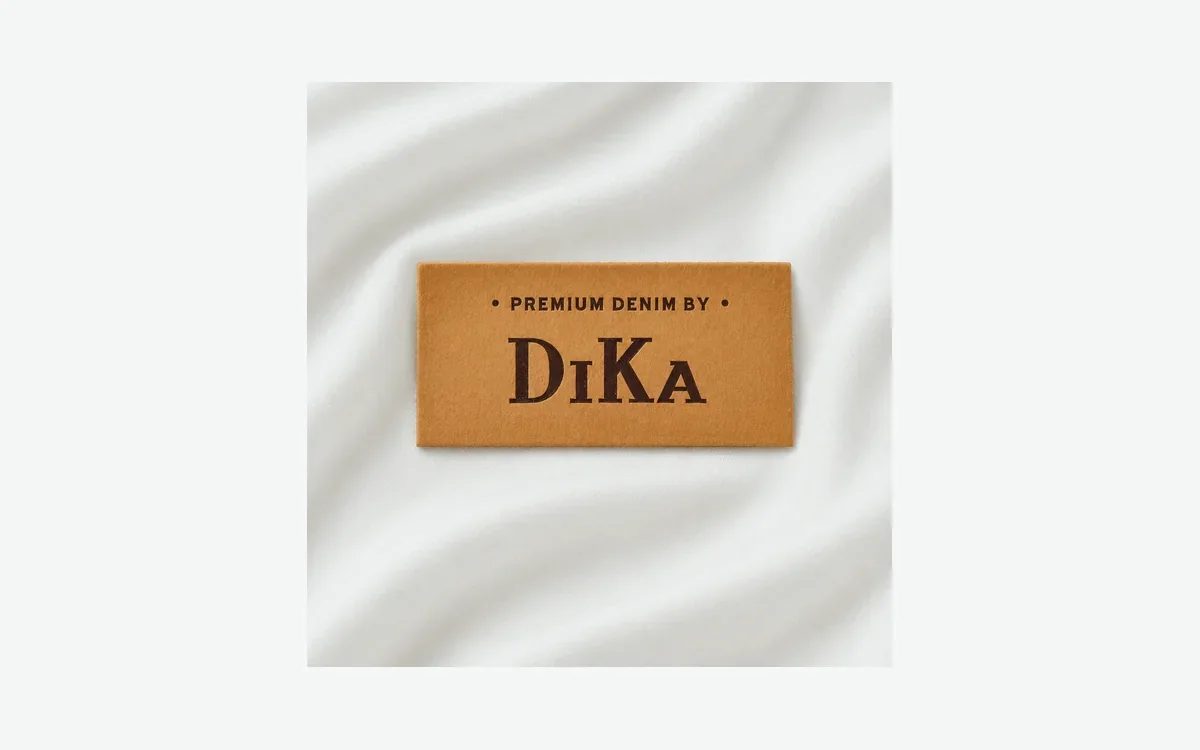
Garments with non-textile parts of animal origin must carry the phrase “Contains non-textile parts of animal origin” in the required language. Typical triggers are a genuine leather patch on jeans, horn or mother-of-pearl buttons, a fur trim or feathers in padding. Brands that order leather labels for the first time often forget this line, so we flag it during proofing.
Step four: cover every sales language
The composition must be in the official language or languages of each member state where the garment is offered to consumers, unless that country permits otherwise. Selling in Finland means Finnish and usually Swedish; selling in Belgium can mean French, Dutch and German. The same information must also be visible before purchase in online shops and catalogues.
The text must be durable, legible, visible and accessible, and a label must be firmly attached. One typeface, size and style is required for the composition itself.
Care symbols: expected rather than mandated
EU law does not itself require care instructions, but retailers and consumers expect them and several non-EU markets demand them.
The reference standard is ISO 3758 (2023 edition). The symbols are registered trademarks of GINETEX in many countries and always follow the same sequence:
| Position | Symbol | Covers |
|---|---|---|
| 1 | Washtub | Washing |
| 2 | Triangle | Bleaching |
| 3 | Square | Tumble and natural drying |
| 4 | Iron | Ironing |
| 5 | Circle | Professional dry and wet cleaning |
The 2023 edition introduced a hand-wash symbol at ambient temperature and an iron-without-steam symbol, and several symbols were redrawn. If your artwork predates it, update it now. Never restyle the symbols to match your brand font.
Country of origin
Inside the EU a “Made in” line is generally voluntary but must be accurate when used. Markets such as the United States require origin marking and a manufacturer identifier, so plan those lines at the design stage.
Turning the rules into a working label
The information must survive the garment’s life. On our care labels we typically recommend:
- Polyester satin or nylon taffeta tapes printed with wash-resistant inks matched to the declared wash temperature.
- Ultrasonically sealed edges, which feel soft and give customers no reason to cut the label out.
- Booklet labels with several stacked panels when ten or more languages are needed, rather than shrinking type until it becomes unreadable.
- A side-seam or centre-back position where the label is easy to find.
Our label size guide helps you pick a tape width and length that fits your content.
Looking ahead: the Digital Product Passport
Under the Ecodesign for Sustainable Products Regulation, (EU) 2024/1781, in force since July 2024, textiles are expected to receive a Digital Product Passport: data on materials, origin, repair and recycling reached through a carrier such as a QR code. The sewn label stays; many brands are adding a durable code. Our QR and DPP-ready labels are designed for this.
Pre-order checklist
- Annex I fibre names, weight percentages, descending order.
- Separate composition for shell, lining and other main parts.
- Animal-origin statement where relevant.
- Every language for every sales country.
- ISO 3758:2023 symbols in the correct order, with consistent text.
- Origin and export-market data if needed.
- Wash-resistant tape and ink, suitable fold and agreed position.
Send us your composition, sales countries and care instructions and our design team will return a digital proof, typically within 24–48 hours, using OEKO-TEX certified materials. Write to [email protected] or message +359 876 766 050 on WhatsApp or Viber.
Does every garment sold in the EU need a composition label?
Most textile products do under Regulation (EU) No 1007/2011. Annex V lists exemptions and Annex VI covers products that may share one inclusive label, so check those for unusual items.
Can I write “Lycra” instead of “elastane”?
Only alongside the official name. The Annex I fibre name, here elastane, must appear; a trade name can be added next to it.
My jeans have a leather patch. What do I add to the label?
Add “Contains non-textile parts of animal origin” in each required language. The same applies to horn buttons, fur trims and feathers.
How do I fit fifteen languages on one care label?
A booklet label with several printed panels sewn together at one end is the usual solution. It keeps the type legible while carrying all languages.