A label marks one spot on a garment. A branded woven tape can carry your name along an entire seam, a drawstring or a gift box. Here is how jacquard logo tapes are made, where they work best and what to specify when you order them from a manufacturer.
Turn a well-finished hoodie inside out and you will often find the brand name running across the back neck seam. Open a premium shirt and the same name may appear inside the placket. Tie up the shopping bag, and the ribbon repeats it once more. All three can be woven on the same narrow-fabric looms we use for woven labels, creating a consistent trim language from product to packaging.
How a logo is woven into tape
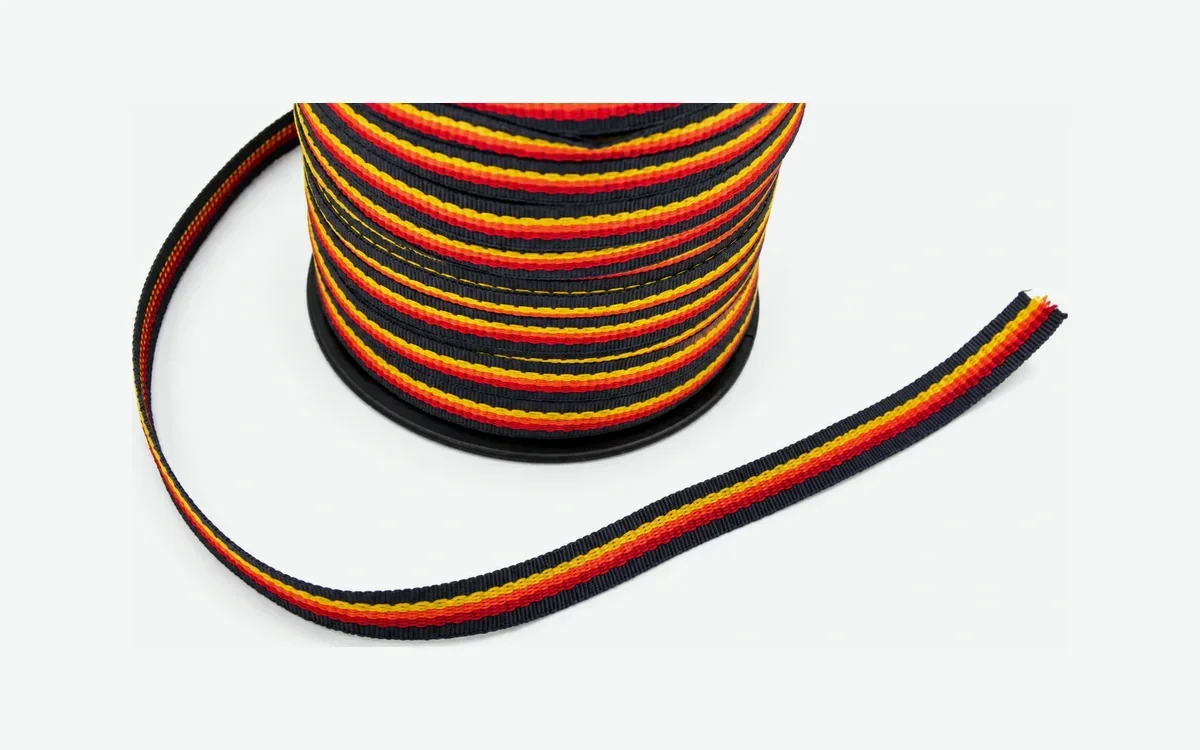
Branded tape is produced in continuous lengths on a narrow loom fitted with a jacquard head. The jacquard lifts warp threads individually, which lets the weft build letters, symbols or patterns across the width. The motif becomes part of the cloth itself: crisp on the face and, depending on the weave, mirrored or simplified on the back. Nothing is printed on top, so there is no coating to crack or peel.
Polyester is the usual yarn because it is strong, colourfast and dimensionally stable through repeated washing. Cotton gives a softer, more natural handle for organic and heritage ranges. Tapes can be woven with OEKO-TEX Standard 100 certified yarns, and recycled polyester with GRS-certified material is available on request.
Choosing the weave
| Structure | Character | Usual widths | Where it shines |
|---|---|---|---|
| Herringbone | Zigzag twill, flat, soft, hard-wearing | 10–25 mm | Neck tape, seam covering, drawstring channels, workwear |
| Plain or twill jacquard | Smooth, flat, sharp logo detail | 10–50 mm | Logo tapes with fine text, plackets, drawstrings |
| Grosgrain | Fine crosswise ribs, matt, firm | 6–40 mm | Packaging ribbon, bows, hat bands, facings |
| Satin | Lustrous, very soft, fluid drape | 6–50 mm | Lingerie, hanger loops, premium packaging |
Herringbone lies flat and sews easily, which is why it dominates neck and seam applications. Grosgrain ties a crisp bow and holds its edge. Satin feels the most luxurious but its long surface floats can snag, so keep it for loops, lingerie and packaging. For small lettering, a fine plain or twill jacquard reproduces detail most sharply – ask for a woven sample if your logo has tiny text.
Five places a logo tape earns its keep
- Back neck seam on T-shirts, sweatshirts and hoodies – usually 10–15 mm, soft herringbone or twill, with a short logo repeat so every size shows the name.
- Plackets, facings, flies and pocket bags – 10–20 mm flat weaves sew neatly along straight edges and reward the wearer with a detail they discover later.
- Flat drawstrings in joggers, shorts, hoods and bags – firm enough to thread, soft enough to knot, with sealed or tipped ends and a repeat planned so the logo shows on both hanging ends.
- Hanger loops for coats, dresses and knitwear, cut from the same tape.
- Packaging ribbon for gift boxes and paper bags – typically 15–40 mm satin or grosgrain in your brand colour.
Many brands keep plain tape for basics and reserve logo tape for core or premium lines, so the trim itself signals the tier.
Width, repeat and supply format
| Width | What fits |
|---|---|
| 6–8 mm | A short wordmark or symbol – fine loops, lingerie |
| 10 mm | One line of bold text – T-shirt neck tape |
| 15 mm | Logo plus a short tagline – sweatshirt neck, placket |
| 20–25 mm | Logo with border or pattern – drawstrings, hood trims |
| 30–40 mm | Larger logo, two-colour motifs – ribbon, bag handles |
| 50 mm | Full logo with detail – statement trims, wide ribbon |
The repeat is the distance between logos. Around 40–80 mm keeps the name visible on short sections such as a neck seam; a longer, airier repeat looks calmer on ribbon. Tape is ordered by the metre and commonly supplied on 50 or 100 m rolls for reel-fed sewing. Alternatively, we cut it to length with sealed ends, so your factory receives ready-to-sew loops or drawstrings. If the logo must be centred on each piece, choose cut pieces – centring is controlled at cutting.
Details that prevent surprises
- Two or three colours keep a narrow weave balanced; wider tapes allow more. Metallic yarn can highlight a border or logo.
- All colours are matched to Pantone references.
- Ask for a soft finish on skin-contact tapes and a firmer finish on ribbon that must hold a bow.
- Keep lettering clear of the tape edges so stitching never cuts through it.
- Cotton tape can shrink differently from the garment – wash-test a sewn sample first.
- Coordinate tape, labels and hang tag strings in one palette.
Ordering from us
Tell us the application, width, weave and supply format (rolls or cut pieces), the repeat and the quantity in metres or pieces, and send your logo as a vector file with Pantone references. Our design team prepares a digital proof, typically within 24–48 hours, and a physical sample if you want one. Minimums depend on width and design and are confirmed with your quotation – they are low per design, so just ask. Production typically takes 10–20 working days after approval, with EU delivery from our facility in Bulgaria. See the range on our woven tapes and ribbons page or write to [email protected].
Frequently asked questions
Will a woven logo on tape fade or peel?
No. The logo is formed by the yarns themselves, so there is no print layer to wash out or crack.
Which tape works best for a hoodie neck seam?
A soft herringbone or twill of about 10–15 mm with a short logo repeat is comfortable and shows the name on every size.
Can I get tape cut into drawstrings or loops?
Yes. As the manufacturer we cut tape to length with sealed ends, so pieces arrive ready to sew.
Can the same logo appear on my packaging ribbon?
Yes. Satin or grosgrain ribbon in your colours can carry the same design as your garment tape.
Are sustainable tapes available?
Yes: OEKO-TEX Standard 100 certified yarns and recycled polyester with GRS-certified material on request.