Picture a rail of forty shirts in a boutique. Before anyone checks a seam or a size, their fingers find the swing tag. That small piece of card sets the price expectation, carries the barcode and tells the brand story in a few square centimetres, so the paperboard it is printed on deserves as much thought as the artwork.
As a hang tag manufacturer, we see the same pattern with most brands: the design is finished first, and the card is chosen at the last minute. Reversing that order gives better results. This guide starts with the material, then moves to finishing, formats, attachment and finally how to order tags in volume without filling a storeroom.
Start with the job the tag has to do
A swing tag works for three audiences. The shopper reads it as a signal of quality. The shop uses it as a data carrier for style number, size, colour and price. The warehouse relies on it for scanning and re-pricing. A premium knitwear label will lean towards feel and finish; a sportswear range sold through large retailers will lean towards a clean barcode area and robust card that survives handling.
Paperboard grades at a glance
Most garment tags are printed on board of roughly 300 to 600 g/m². Weight alone does not decide the result; the surface and the type of board matter just as much.
| Paperboard | Usual weight | Character | Suits |
|---|---|---|---|
| Coated white | 300–400 g/m² | Bright, smooth, sharp colour | Full-colour branding, sportswear, busy reverse sides |
| Uncoated white or cream | 350–450 g/m² | Soft, matt, natural | Minimal brands, premium basics, embossed logos |
| Kraft | 300–450 g/m² | Brown, honest, rustic | Denim, outdoor, workwear, natural-fibre lines |
| Through-coloured or textured | 350–500 g/m² | Colour runs to the edge, tactile surface | Premium ranges, accessories |
| Laminated double layer | 600–1,000 g/m² | Thick, rigid, optional contrast core | Outerwear, knitwear, gift items |
A few practical notes on each
Coated board reproduces photographs and small type crisply, so it is the safe option when the back of the tag carries a lot of information. Uncoated board prints colours slightly softer but takes a deboss beautifully. Kraft looks best with dark inks or white ink. Through-coloured board keeps a black or navy edge when the tag is cut, which looks far more refined than a printed solid. Laminating two layers together lets you show a contrasting colour along the edge.
Pick one finish and do it well
Finishing turns a printed card into something recognisable. The options we produce most often for clothing tags are:
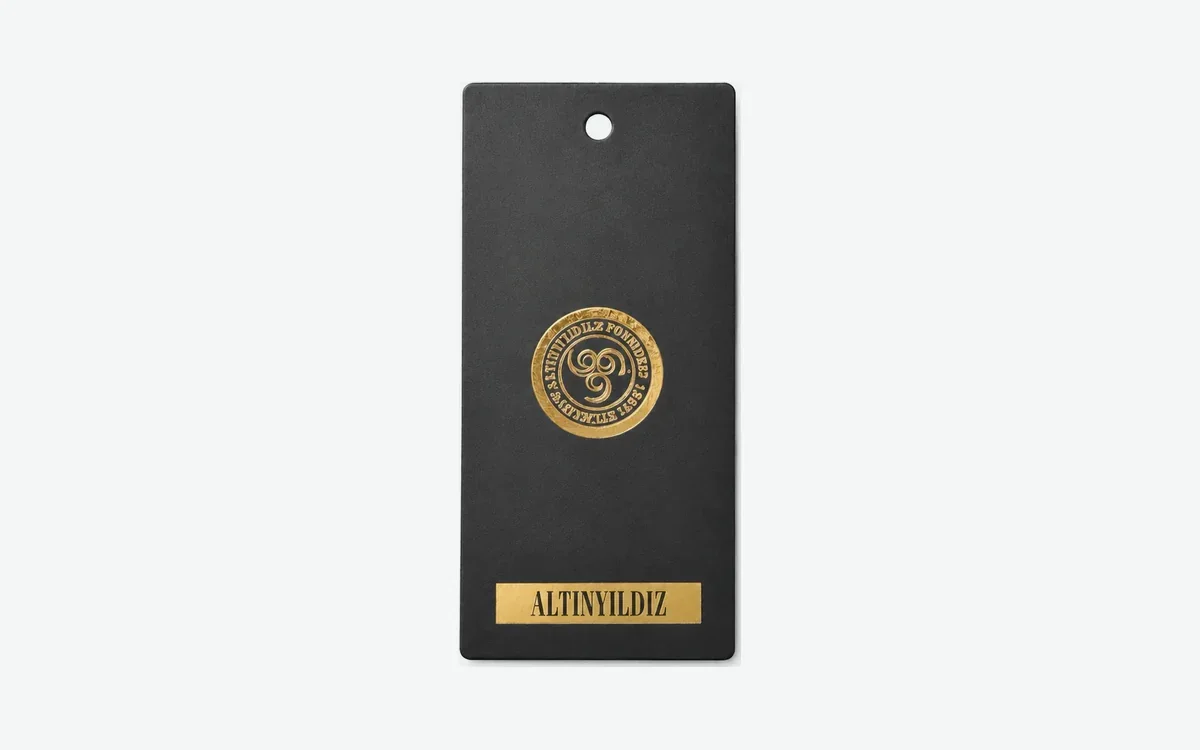
- Hot foil in gold, silver, copper or a colour, for a logo or a small detail
- Embossing or debossing, ideal on thick uncoated or textured board
- Spot UV varnish, a glossy accent on a matt surface
- Matt or soft-touch lamination, which also protects the tag against scuffing in transit
- Die-cut shapes such as rounded corners, arches or circles
- Metal eyelets around the hole, always nickel-free in our production
Our advice is restraint. A single strong effect, such as a deep deboss on 600 g/m² cream board, usually says more than foil, varnish and lamination competing on the same card. If recyclability is part of your brand promise, discuss lamination with us before you approve the design.
Formats that work on the shop floor
Rectangular formats are efficient to print and easy for shops to handle. Popular sizes include 50 × 90, 50 × 100, 55 × 85, 60 × 100 and 40 × 70 mm, plus squares around 60 × 60 mm for accessories. A folded tag, for instance 100 × 90 mm folding to 50 × 90 mm, gives four panels for a story, several languages or a care reminder. Very small tags of around 30 × 50 mm suit socks, underwear and childrenswear. Custom dimensions are possible for every shape; see our label size guide for more reference points.
Attachment is part of the design
How the tag hangs changes how it looks on the rail. Cotton string, waxed cord, elastic cord and ribbon feel boutique; plastic tag pins and seal tags are faster on a production line and add security in retail. Decide the attachment together with the artwork and specify string colour and length, typically 15–20 cm, in the same brief. We can also supply matching woven tapes and ribbons if you want the string to echo your label colours.
Ordering swing tags in volume
Tags are consumables: every garment you ship uses one. The way you structure the order has a large effect on efficiency and waste.
- Keep the core design constant. Logo, brand message and website can stay identical across dozens of styles.
- Move variable data elsewhere. Put size, colour, barcode and price on a small sticker or a blank field printed later. You then reorder one tag design in larger runs instead of many small ones. Our stickers and packaging labels cover that part.
- Plan by season, not by style. Estimate total units across the season and add a small buffer for losses and reorders.
- Lock the specification. Once board, finish and size are approved, repeat orders match the first run exactly.
As the manufacturer, we prepare a digital proof for your approval and can produce physical samples before production, so you can check board thickness and finish in your hand. Production typically takes 10–20 working days after approval, with delivery across the EU from Bulgaria. Browse the full range on our hang tags page.
Frequently asked questions
How thick should a clothing swing tag be?
For most fashion items, 350–450 g/m² feels solid without being bulky. Premium outerwear and knitwear often use laminated board of 600 g/m² or more, while small accessories work well with lighter card.
Can I print the size and price on the tag itself?
You can, but it multiplies the number of designs. Many brands print a shared tag in a large run and add size, barcode and price with a small sticker, which keeps reorders simple.
Which board suits a denim or workwear brand?
Kraft board is the most common choice, printed in black or white ink. A deboss or a metal eyelet adds a durable, workwear-style finish.
Will I see a sample before the full order?
Yes. We send a digital proof first and can make physical samples before production, so you can judge the card, colour and finish on the actual garment.
Can swing tags match my woven labels and packaging?
Yes. Because we produce labels, tags and packaging ourselves, we can match Pantone colours across the whole set, from the neck label to the box.