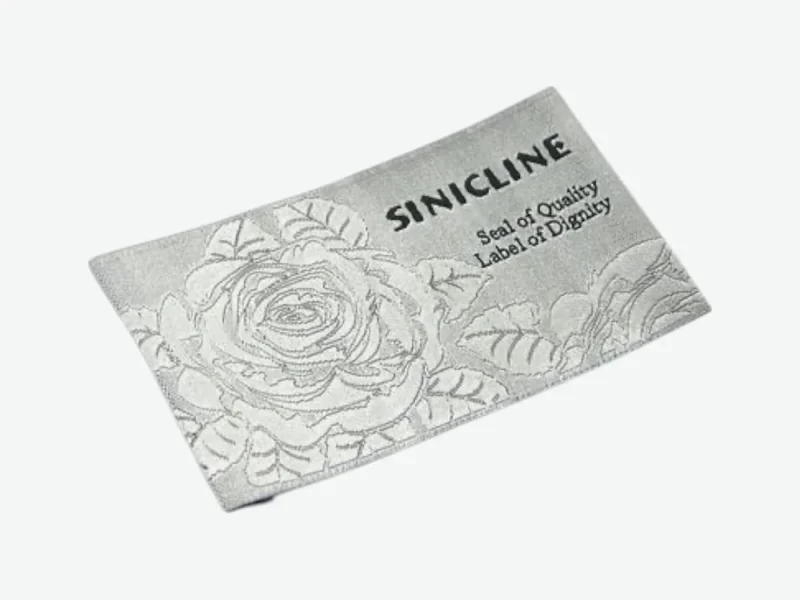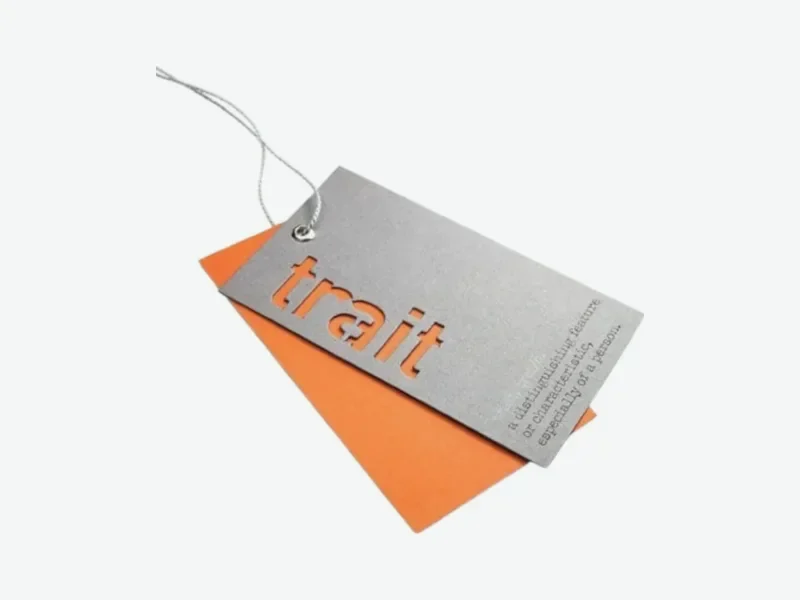
Pick up two swing tags with identical artwork, one on light card and one on heavy board, and you will judge the garments differently before you read a word. Dimensions and board weight are quiet decisions with a loud effect. This reference helps you specify both by product type.
We cut, print and finish swing tags in our own production in Bulgaria, and every size below is a starting point rather than a rule. Any custom size or outline is possible.
Start with what the tag must carry
Count the content before choosing a size. A tag for a basic tee may need only a logo, a size and a barcode. An outerwear tag may carry technical features, a material story and several languages. More content means either a larger format or a folded tag.
Typical formats by product
| Product | Suggested size (mm) | Why it works |
|---|---|---|
| Basics, tees, underwear | 40 × 70 or 50 × 90 | Small enough for high volumes, room for size and barcode |
| Shirts, dresses, knitwear | 50 × 90 or 50 × 100 | The all-round format for most garments |
| Coats and outerwear | 60 × 100 and up | Space for technical and material details |
| Denim | 60 × 100, often die-cut | Pairs with heavy board and leather patches |
| Caps, scarves, accessories | 55 × 85 or 90 × 50 landscape | Fits small items and display hooks |
| Baby and kidswear | 40 × 70 or 50 round | Rounded corners for a softer look |
| Folded tags | 50 × 90 folding to 50 × 45 | Extra panels for languages or size charts |
For dimensions across all trims, see our label size guide.
Board weight: what the numbers mean in the hand
Board is specified in grams per square metre. Heavier usually means thicker and stiffer, but board type matters too: an uncoated or recycled board feels bulkier than a coated board of the same weight.
| g/m² | How it feels | Where it fits |
|---|---|---|
| 300 | Flexible, like a heavy postcard | Basics, large ranges, folded tags |
| 350 | Firm and balanced | The everyday choice for most garments |
| 400–450 | Stiff, noticeably premium | Knitwear, outerwear, gift lines |
| 500–600 | Rigid, almost like thin board | Denim, premium lines, shaped tags |
| 2 × 300 layered | Thick and solid | Luxury tags with contrasting edges |
A useful rule: the more elaborate the die-cut, the heavier the board should be, because thin board bends at narrow points.
Layered and laminated tags
Two boards laminated together create a substantial tag and allow a coloured core that shows on the edge, or different colours front and back. Surface laminates add protection: matt or soft-touch film resists scuffs and moisture and feels velvety, while gloss film makes colours more vivid.
Finishes worth considering
- Hot foil in gold, silver, copper or pigment colours for the logo.
- Embossing or debossing, with blind (unprinted) versions looking especially refined on heavy uncoated board.
- Spot UV for a gloss logo on a matt surface.
- Die-cutting for rounded corners, shaped tops or windows.
- Edge colour on thick or layered tags.
Foil and emboss details need slightly bolder lines than standard print. Our digital proof shows the proportions before anything is made.
Holes, eyelets and attachment
The string hole is typically 4–5 mm across, centred near the top and about 5–8 mm from the edge so the board does not tear. On landscape tags a hole in the top-left corner makes the tag hang at an angle, which can look deliberate and distinctive. Metal or coloured eyelets reinforce the hole on heavy tags and add a finishing detail. Keep text clear of the hole and the path the string takes.
Common attachments include:
- Cotton or polyester string, typically 15–20 cm, knotted or closed with a seal; waxed cotton, twisted cord and elastic loops are also possible.
- Plastic seals that close the loop and can carry your logo.
- Lock pins and tagging pins for fast lines and multipacks.
- Small safety pins for delicate fabrics, attached through a seam or label.
Recycled board options
Recycled board is available in most weights, in natural white, kraft brown and colours. Its slightly textured surface suits single-colour print and blind embossing. Pair it with cotton string and skip plastic lamination for a coherent sustainability message. Our label materials guide covers the wider options.
Order tags with the rest of the set
Swing tags often share artwork with stickers and packaging labels. Producing them together keeps colours aligned across the brand. Minimums are low per design – ask us for your quantity. Production typically takes 10–20 working days after proof approval, with delivery across the EU.
Send us the product type, preferred size, board and finish, or just a sketch, to [email protected] or WhatsApp/Viber +359 876 766 050. Browse formats on our hang tags page.
What is the most common swing tag size?
Around 50 × 90 mm suits most shirts, dresses and knitwear. Basics often use 40 × 70 mm and outerwear 60 × 100 mm or larger.
Which board weight should I choose?
350 g/m² is a balanced everyday choice. Go to 400–450 g/m² for a premium feel and 500–600 g/m² for denim or shaped tags.
Why does my recycled tag feel thicker than a coated one of the same weight?
Uncoated and recycled boards are bulkier, so they feel thicker at the same g/m² than smooth coated board.
Where should the string hole go?
Typically centred near the top, about 5–8 mm from the edge, with a 4–5 mm diameter. A corner hole on a landscape tag makes it hang at an angle.