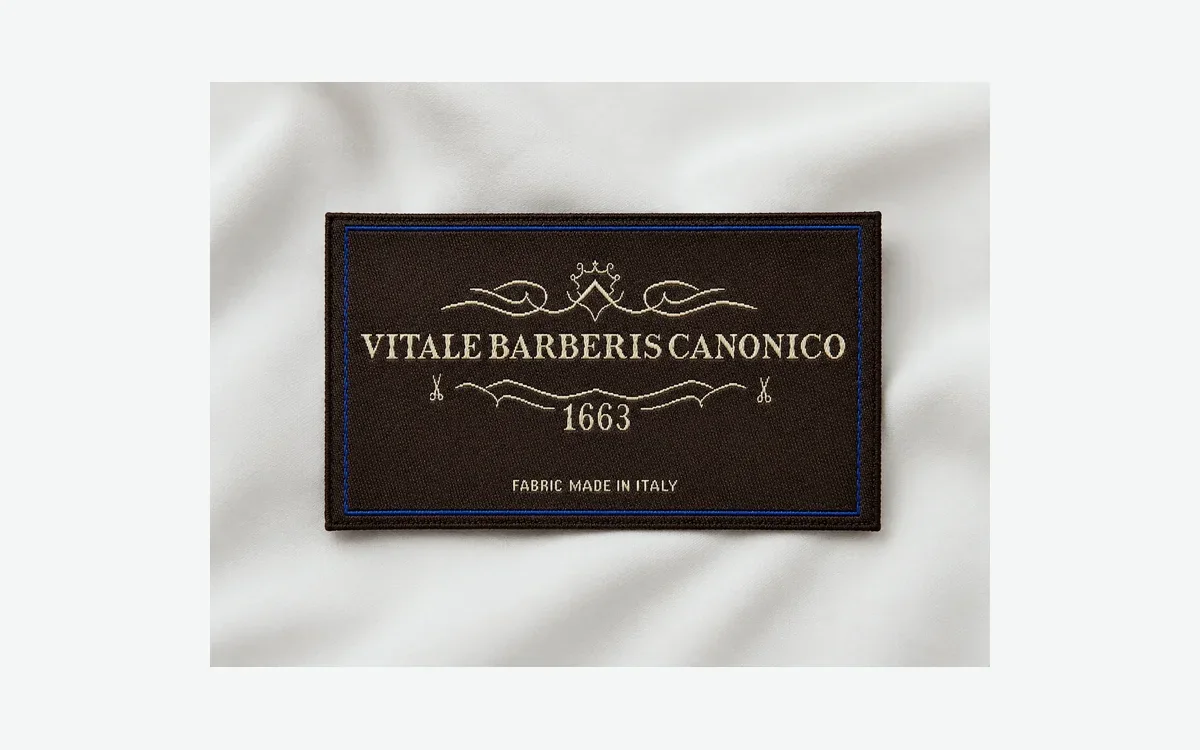
A bath towel may go through the washing machine at 60 °C every week for years. A duvet cover is stripped, washed, ironed and folded into a cupboard again and again. Labels for towels, bed linen, throws and curtains have to keep pace with that routine. Here is how we approach home textile labels as a manufacturer, product by product.
The basic label set for household textiles
Most home textile products carry up to three pieces of labelling:
- A brand label – typically a woven label in a hem or seam, or a woven loop on a towel.
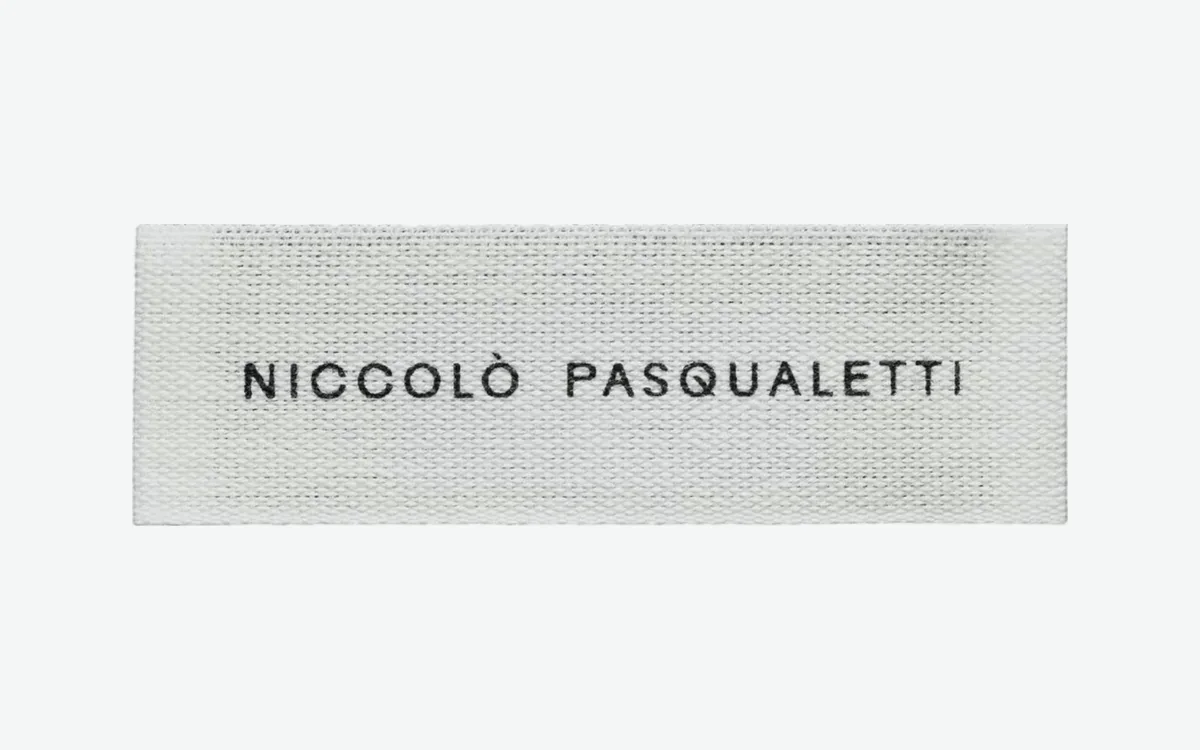
- A care and composition label – fibre content is mandatory in the EU; on large items it usually also states the finished size and article number.
- Packaging labelling – a band, sleeve, box or sticker showing set contents, sizes and barcode. See stickers and packaging labels and custom boxes.
Towels: when the label is also the hanging loop
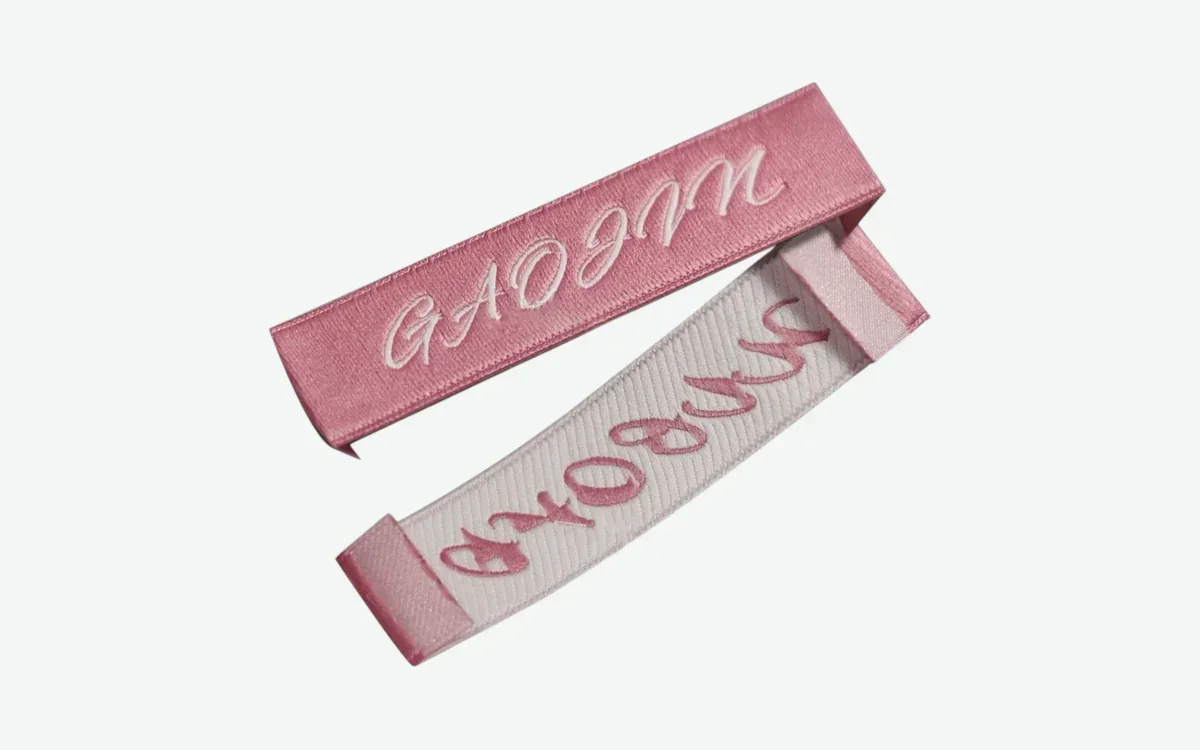
Towels are the one product where a label often has a mechanical job. A strip of sturdy woven tape, folded into a loop and sewn into the hem, gives you a hook loop and a brand mark in one piece. For a spa hotel’s guest towels, for instance, a 20 mm white damask loop with a tone-on-tone logo looks refined and survives laundry well. Typical loop labels are 15–25 mm wide and 60–100 mm long before folding.
Other options are a small end-fold tab that peeks out of the side hem, or a logo woven into the jacquard border of the towel itself with only a care label in the hem. Whatever you choose, select colourfast yarns that will not bleed onto white terry, and ultrasonic-cut care labels that stay soft against the pile.
Bed linen: make the size impossible to miss
When a fitted sheet is folded on a shelf, nobody can tell a single from a double. That is why the size – for example 160 × 200 cm – should be printed in a clear, large font on the care label. Good practice for bedding:
- use a care label 30–40 mm wide, so size and symbols are legible;
- place it on the closure side of a duvet cover or in a corner seam, away from the sleeping surface;
- label every piece of a set separately, because pillowcases and sheets part company after the first wash;
- add a small woven brand label on the closure flap if you want the brand visible on a made bed.
Throws, blankets, curtains and cushions
Wool and wool-blend blankets need gentle care, so the care label must be easy to find – a corner seam is ideal. A woven brand label alongside it, or a genuine or faux leather label on a knitted throw, adds a premium touch. Fleece and acrylic throws pair well with a printed satin care label.
Curtains are washed rarely but exposed to daylight for years. Sew the care label into the heading tape or side hem where it is hidden when hanging, and choose a light-resistant material so the text is still readable the day the curtains finally go to the cleaner.
Cushions are labelled in the zip seam. Cover and filling are two components, and the composition of each should be clear; if the filling contains feathers or down, non-textile parts of animal origin must be declared.
Quick reference: sizes and wash ratings
| Product | Label | Typical size | Typical wash to design for |
|---|---|---|---|
| Cotton towels | Woven loop + care label | 15–25 mm loop; care 25–30 × 50–80 mm | 60 °C, tumble dry |
| Cotton bed linen | Care label with size | 30–40 × 60–120 mm | 40–60 °C, medium-hot iron |
| Poly-cotton bed linen | Care label with size | 30–40 × 60–120 mm | 40 °C, cooler iron |
| Bed linen sets | Woven brand label | 15–20 × 40–60 mm | As the set |
| Wool blankets | Woven or leather brand label | 20–40 × 50–80 mm | 30 °C wool cycle or hand wash |
| Fleece throws | Printed care label | 25–30 × 50–80 mm | 30–40 °C, no iron |
| Curtains | Colourfast printed care label | 25–35 × 60–100 mm | 30–40 °C or professional |
Always base the care instructions on tests of your own fabric. The label itself must survive the toughest treatment you allow: a towel label marked for 60 °C must withstand 60 °C and tumble drying too. Care symbols follow ISO 3758 in the order washing, bleaching, drying, ironing and professional care. Our care labels and label materials guide cover the options in detail.
EU composition rules apply to the home as well
Regulation (EU) No 1007/2011 covers household textiles just as it covers clothing. Composition must be given by weight percentage using official fibre names, such as “100% cotton”, in the official language or languages of each country of sale. Multi-component products such as quilted bedspreads list each component. A booklet care label is a practical way to fit many languages on one piece.
Sewing tips from the production floor
- Catch the label in the seam with 8–10 mm of allowance so it cannot pull out.
- Choose OEKO-TEX certified labels for bedding and towels, which are in long skin contact.
- For sustainable collections, ask about recycled polyester labels with GRS certification.
- Match ink and tape to the highest temperature on your care label.
Getting started
Send us your product list with sizes, compositions and care instructions, plus your logo. As the manufacturer, we prepare a digital proof, typically within 24–48 hours, and physical samples before production. Production typically takes 10–20 working days after approval, with delivery across the EU from Bulgaria. Minimums per design are low – ask us at [email protected] or WhatsApp/Viber +359 876 766 050.
Frequently asked questions
Can a towel label double as a hanging loop?
Yes. A folded woven tape sewn into the hem works as both brand label and loop. Typical widths are 15–25 mm.
Why should the size be on a bed linen care label?
Folded sheets and covers look alike. A clearly printed size such as 140 × 200 cm helps customers and stores pick the right piece.
Where is the best place for a curtain care label?
In the heading tape or a side hem, hidden when the curtain hangs, and printed on a light-resistant material.
Do cushions need composition for the filling too?
Yes. Cover and filling are separate components, and down or feathers must be declared as non-textile parts of animal origin.
Do you offer recycled labels for home textiles?
Yes. Recycled polyester labels with GRS certification are available on request.