A good metal plate is readable at arm’s length, sits flat on its surface and keeps its finish after years of handling. Those three qualities are decided long before production, at the drawing stage.
Brands often come to us with a logo and a rough idea: “a gold plate for the bag flap”. As a manufacturer of metal logo plates, we turn that idea into a technical drawing, and we ask the same questions every time. Here they are as a checklist you can work through on your own.
Question 1: what surface is the plate going on?
Everything starts here. A 0.5 mm plate that looks delicate on a knitted cuff will feel flimsy on a leather briefcase. A 2 mm cast plate that suits an armchair will pull a T-shirt out of shape. Note the material (fabric, leather, wood, plastic, card), whether it is flat or curved, and how often it will be handled or washed.
Question 2: which outline?
- Rectangle: the classic for waistbands, pockets and bag fronts. Rounded corners with a 1–3 mm radius feel softer and catch less on fabric.
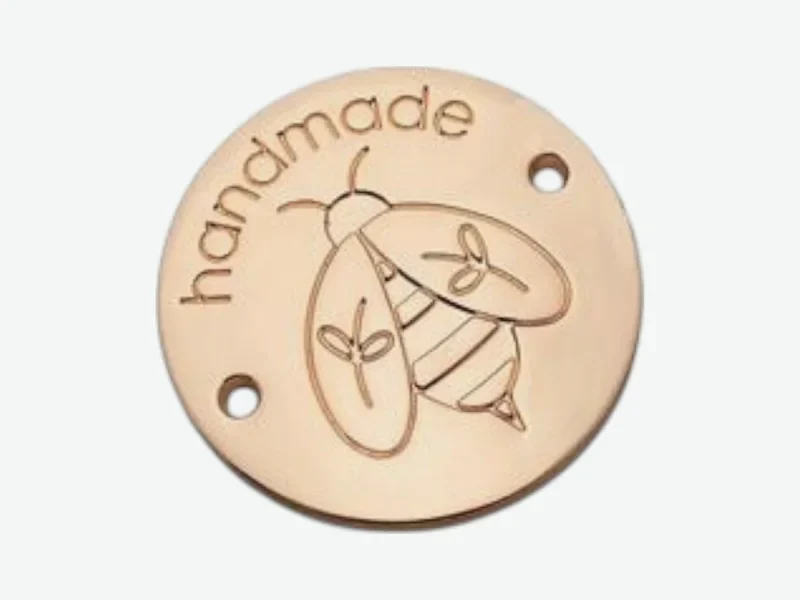
- Oval or round: balanced around a centred logo; popular on caps, furniture and heritage styles.
- Bar: long and narrow, for example 40 × 6 mm, for straps, sleeves, belts and handles.
- Logo outline: die-cut to follow the mark itself, so the plate reads as a symbol.
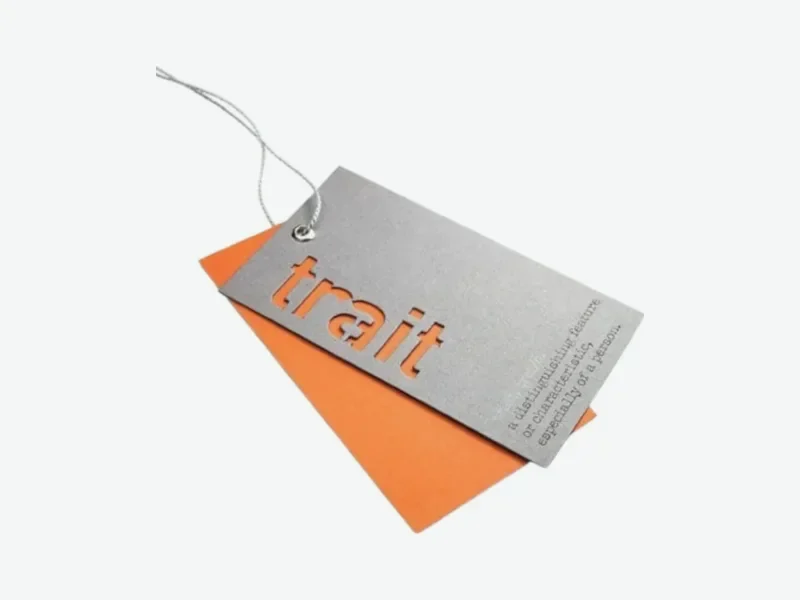
- Cut-out lettering: the surface underneath shows through, which works beautifully on leather or dark fabric.
Question 3: how thick, and what kind of edge?
Stamped plates from brass, aluminium or stainless steel sheet are typically 0.4–1.0 mm. Die-cast zinc alloy plates usually start around 1.2 mm and can reach 3 mm or more for deep relief. A bevelled or rounded edge makes a thick plate look refined; a straight cut gives a technical, industrial feel. Thin plates can be pre-curved to sit flush on a cap front or bag gusset.
| Application | Size range (mm) | Thickness (mm) | Common fixing |
|---|---|---|---|
| Jeans waistband or pocket | 30 × 8 to 50 × 15 | 0.6–1.2 | Prongs or rivets |
| Jacket chest or sleeve | 40 × 10 to 60 × 15 | 0.6–1.5 | Prongs or stitch holes |
| Knitwear hem or cuff | 20 × 5 to 30 × 8 | 0.4–0.8 | Stitch holes |
| Caps and hats | 25 × 8 to 40 × 12, or 15–25 round | 0.5–1.0 | Stitch holes or prongs |
| Bags and leather goods | 40 × 12 to 70 × 20 | 1.0–2.0 | Screws, rivets or prongs |
| Furniture, cases, gift boxes | 40 × 15 to 80 × 25 | 1.0–2.5 | Screws, pins or adhesive |
Question 4: how will the logo be made?
| Method | Result | Detail | Choose it when |
|---|---|---|---|
| Laser engraving | Flat, sharp contrasting mark | Very fine | You need small text, serial numbers or several variants |
| Stamped emboss / deboss | Tactile relief in sheet metal | Bold lines | The design repeats season after season |
| Cast relief | Sculpted, several depths | Medium to high | Depth and weight are part of the brand |
| Enamel fill | Solid colours framed by metal | Medium | The logo has one to four flat colours |
| Print under epoxy | Glossy full colour | Photographic | Gradients or multicolour artwork |
Laser engraving needs no tool, so changing the text is easy. Stamping and casting use a die or mould, which pays off on repeat orders. Enamel colours are matched to Pantone references, and each colour needs its own area divided by a thin metal line.
Question 5: which finish fits the rest of the hardware?
- Gold tones: bright gold, light gold, rose gold, champagne.
- Silver tones: silver, chrome-look, nickel-look (a colour name only; our plates are nickel-free).
- Dark tones: gunmetal, black, black chrome-look.
- Antique: brass, silver or copper with darkened recesses that make relief stand out.
- Texture: polished, matt, satin, brushed, sand-blasted, or two textures on one plate.
- Colour: anodised aluminium or painted surfaces.
Lay the plate next to the zip pullers, buttons and buckles of the product. If they do not belong together visually, adjust the finish rather than the hardware. A clear lacquer adds resistance to abrasion and humidity.
Question 6: where are the fixing points?
Prongs suit denim, jackets and bags; rivets give permanent hold on heavy fabric and leather; stitch holes are the gentle option for knitwear, caps and soft goods; screw posts or countersunk holes keep plates firm on luggage and furniture; adhesive works on smooth boxes and cases. Mark these points on the drawing early and keep them clear of the logo.
Beyond garments
The same production methods serve furniture makers, leather goods workshops, cosmetics packaging and gift boxes. Slim engraved plates also make elegant shelf or display tags in boutiques and showrooms, and a small plate can lift a premium hang tag or custom box.
What happens after the checklist
Send your answers with a vector logo and a product photo. Our design team prepares a dimensioned drawing and digital proof, typically within 24–48 hours, then a physical sample so you can judge weight and finish in your hand. After approval, production typically takes 10–20 working days, with delivery across the EU. See our metal labels range or request a drawing.
What thickness should a metal plate for a bag be?
Plates for bags and leather goods are usually 1.0–2.0 mm. Thicker cast plates suit structured bags; thinner stamped plates suit soft ones.
Can one plate design carry different text?
Yes. With laser engraving we can change names, numbers or codes within one order without a new tool.
Do you make plates for furniture and packaging as well?
Yes. The same metals, finishes and fixings work on furniture, cases, cosmetic packaging and gift boxes.
Can a flat plate sit on a curved cap front?
A thin stamped plate can be pre-curved during production so it sits flush on the panel.