Ten thousand labels that look identical, feel soft at the edge and match the approved sample: that is the outcome every brand expects. Getting there involves very different machines depending on the label type. As a clothing label manufacturer with more than 30 years of experience and our own production in Bulgaria, we can show you what happens to an order once the proof is approved.
Knowing the process helps you prepare artwork and plan time.
Before any machine starts: technical preparation
Every order begins with a technical check of the artwork against the limits of its technique. For weaving that means line thickness and text height; for print, colour separations; for silicone, wall thickness; for metal, relief depth. Colours are matched to Pantone references or to our thread and ink charts.
The file is then translated into the language of the machine: a weaving pattern, a print file or plate, a die drawing or a mould design. If you only have a logo or sketch, our design team builds the artwork and returns a digital proof, typically within 24–48 hours.
Woven labels: thread by thread
On the loom
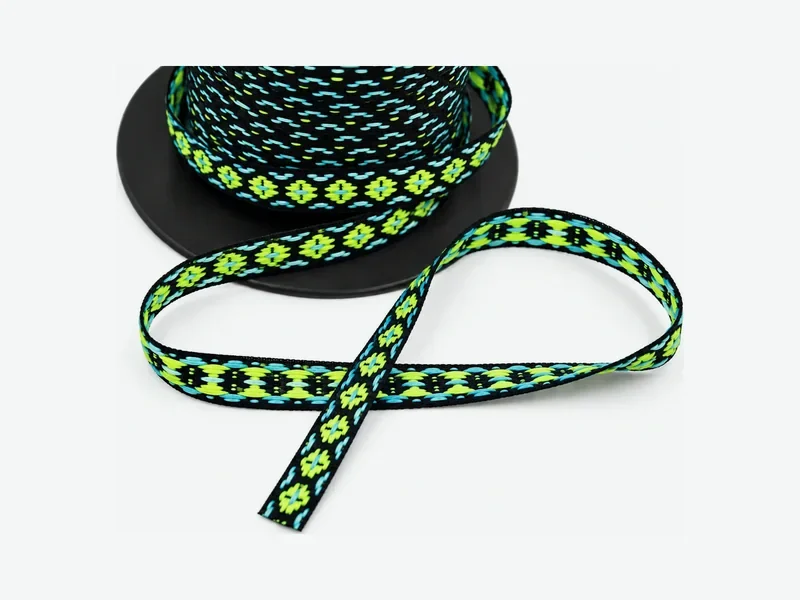
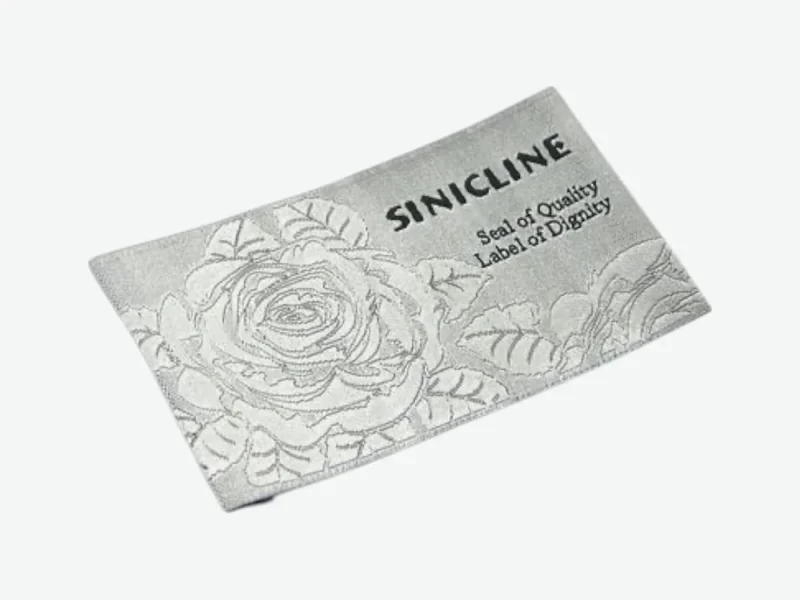
Woven labels are produced on computer-controlled jacquard looms. The pattern tells the loom which warp threads to raise on each pass of the weft. Coloured weft yarns create the logo, while the warp, usually black or white, forms the ground. Damask uses fine yarn for high detail, satin gives a smooth sheen and taffeta a lighter texture. Dozens of labels are woven side by side across the loom width, so one run produces many parallel strips.
After the loom
The woven fabric may be softened, starched for a crisper hand or back-coated to lock the threads. Ultrasonic or heat cutters then separate the strips; ultrasonic cutting seals edges with high-frequency vibration so they stay soft and do not fray. Automatic machines cut each label to length and fold it – straight, end-fold, centre-fold, mitre-fold or loop.
Printed and care labels: flexible by design
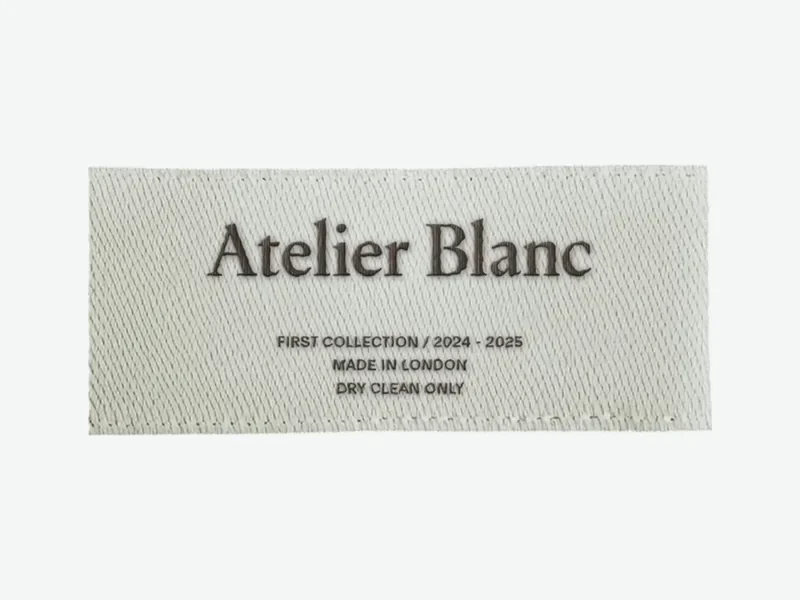
Printed labels start as a tape of satin, nylon taffeta, cotton or synthetic material. Care labels with many variants are typically printed by thermal transfer, where a heated head transfers resin ink from a ribbon to the tape. That makes it easy to switch composition, size or language from one label to the next. Large runs of logos may be printed by flexo or screen. The tape is then cut and folded, or wound onto rolls for factories that cut on their own equipment.
Hang tags: board, finish, die
Hang tags are printed on board, typically 300–600 g/m², by offset or digital printing. Lamination, hot foil, embossing, debossing or spot UV follow. A steel cutting die punches the outline and the string hole, eyelets are set, strings threaded and knotted if required, and tags are counted into bundles. See hang tags.
Silicone labels: moulded in layers
For silicone labels, a metal mould is engraved or machined from the approved design, with separate levels for 2D or 3D relief. Coloured liquid silicone or PVC is filled in colour by colour and cured under heat and pressure. Labels are then released, trimmed and inspected. Heat-applied versions receive an adhesive back.
Metal labels: stamped or cast
Metal labels follow one of two routes. Brass, aluminium and stainless steel plates are stamped from sheet with a hardened steel die that cuts and forms the relief in one action. Zinc alloy emblems are die-cast in a steel mould. Both are deburred, polished, plated, optionally enamelled or laser-engraved and lacquered. Prongs, holes or rivets are added for fixing, and all our metal labels are nickel-free.
Heat transfers and patches
Heat transfer labels are printed in mirror image onto release film and coated with heat-activated adhesive, ready to be pressed onto garments. Woven patches share the label weaving process and add shaped cutting, merrowed or heat-cut edges and iron-on or sew-on backing. Embroidered patches are stitched on multi-head machines and cut to shape.
Process overview
| Label type | Core process | Finishing | Tooling |
|---|---|---|---|
| Woven | Jacquard weaving | Softening or coating, ultrasonic cutting, folding | Weaving pattern |
| Printed and care | Thermal transfer, flexo or screen | Cutting, folding, rolling | Print file or plate |
| Hang tags | Offset or digital on board | Lamination, foil, embossing, die-cutting, stringing | Cutting die |
| Silicone and PVC | Moulding and curing | Trimming, adhesive back | Metal mould |
| Metal | Stamping or die-casting | Polishing, plating, enamel, lacquer | Die or casting mould |
Quality built into each stage
The first pieces off every loom or press are compared with the approved proof or sample for colour, size and detail. Operators take samples during the run, and before packing the labels are checked for weaving faults, print defects, uneven cuts, incorrect folds and colour drift. Textile labels can be produced in OEKO-TEX Standard 100 certified qualities, and recycled polyester with GRS certification is available.
Packed for the sewing room
Finished labels are counted and bundled by design, size or variant, then clearly marked so the sewing line picks the right one. Size and care variants are packed separately. When labels ship directly to your garment factory, cartons carry your style references. Orders are delivered across the EU.
Timing
After proof and sample approval, production typically takes 10–20 working days, depending on type, quantity and finishes. Moulds and dies add time to the first order only; repeats reuse them. Minimums are low per design – ask us for your label type.
Because weaving, printing, moulding and metalwork are planned under one roof, a full label set can be produced to one standard and shipped together. Send your artwork and quantities to [email protected] or WhatsApp/Viber +359 876 766 050, or read more about us.
Why do some labels need tooling and others do not?
Silicone, metal and shaped hang tags need a mould or die cut for your design. Woven and printed labels run from a pattern or print file.
Do I pay for tooling again on repeat orders?
Tooling is made for the first order and reused for repeats, so repeat orders skip that step.
What makes a woven label edge soft?
Ultrasonic cutting, which seals the edge with high-frequency vibration so it does not fray or scratch.
How are care labels with many sizes and languages printed?
Usually by thermal transfer printing, which lets us change content from one label to the next within the same run.