“Can we make the tags FSC?” is one of the most common questions we hear from brands planning a new trim set. The answer is usually yes, but the useful follow-up question is: what exactly do you want to say on the tag? This briefing explains how FSC works so you can make the right choice for your swing tags, boxes, bags and tissue.
As a manufacturer of labels and paper packaging, we can supply FSC-certified paper and board on request across our paper products. Understanding the system first makes the order simpler and your claims accurate.
FSC in one paragraph
The Forest Stewardship Council, founded in 1993, is an international non-profit that sets standards for responsible forestry, covering environmental protection, workers’ and community rights and long-term forest health. It works through two certificate types. Forest Management certification applies to the forest itself. Chain of Custody certification applies to every business that processes or trades the material afterwards, from pulp mill to paper merchant to printer.
The key idea is the chain. Certified fibre entering the system is only half of the story; an FSC claim on a finished swing tag depends on every company that owned and transformed that material holding a valid certificate.
Reading the three FSC labels
| Label | Fibre source | Where you typically meet it |
|---|---|---|
| FSC 100% | Entirely from FSC-certified forests | Premium tag board and rigid box papers |
| FSC Mix | Certified forest fibre, recycled fibre and controlled wood | Most boards, folding cartons and bags |
| FSC Recycled | Entirely reclaimed fibre | Recycled kraft tags, mailers and bags |
Controlled wood is non-certified wood that has been checked to exclude unacceptable sources such as illegal logging. FSC Mix is therefore a practical, credible label that keeps certified supply available at scale.
FSC, recycled and kraft: three different ideas
These terms are often mixed up, yet each describes something different.
- Recycled describes origin: the fibre comes from recovered paper rather than fresh pulp.
- FSC describes verification: the fibre, fresh or recycled, is traced through a certified chain.
- Kraft describes a pulping process that gives strong, long fibres. Brown kraft is unbleached or lightly bleached; white kraft is bleached.
A brown board is not automatically recycled or certified. It may be virgin kraft, recycled kraft or a blend, with or without FSC. Always check the specification of the exact grade.
For design, the difference shows in print. Smooth FSC Mix boards, especially coated grades, hold fine detail, bright colours and foil well. Recycled and FSC Recycled boards have a softer, sometimes flecked surface that suits one-colour print and blind embossing.
Applying FSC across your packaging
Swing tags
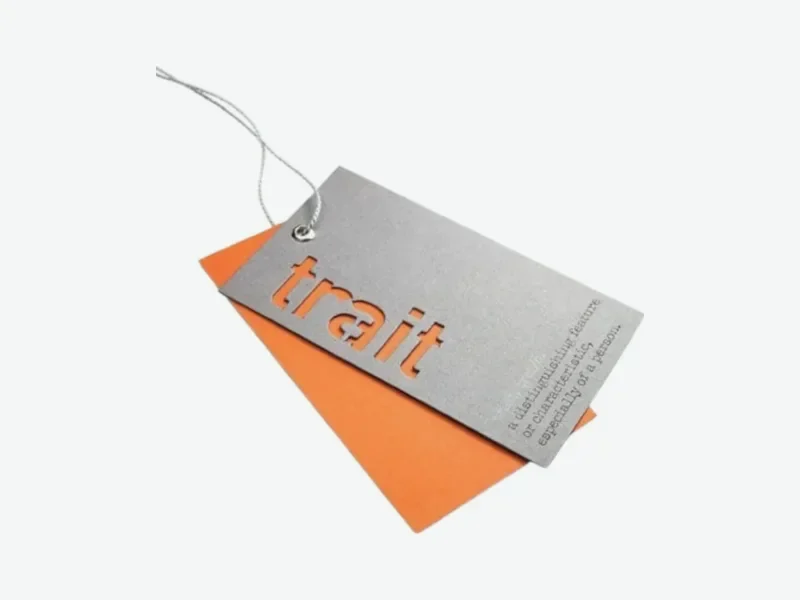
Tag board typically ranges from 300 to 600 g/m², and certified grades exist in white, natural and kraft shades, coated or uncoated. For extra thickness, two sheets can be laminated; check that both layers and the adhesive fit your goals. More on formats on our hang tags page.
Boxes
Rigid boxes combine greyboard with a printed wrap, while folding cartons and mailers use boxboard or corrugated board. Each component can be specified separately in certified or recycled fibre. See custom boxes.
Bags and tissue
Paper shopping bags can be made fully paper-based with twisted or flat paper handles, and wrapping tissue is also available in certified grades. See paper bags and tissue paper.
Printing the FSC logo: the rules of thumb
The FSC trademarks are controlled by FSC. In broad terms:
- The on-product label may only be used when every organisation in the chain that owns and transforms the material is certified.
- The label carries the licence code of a certified organisation and must be approved before printing.
- Brands without their own certificate may still have options under FSC rules; a certification adviser can explain them.
- Without the right certification, do not print the logo or call the product FSC-certified, even if certified paper was used.
Tell us at quote stage if you want an FSC label on your tags or boxes. We check together what is possible for that order and what documentation can accompany it. A fully valid alternative is to use certified paper for its sourcing benefits and describe the material accurately without a logo.
Inks and finishes that keep paper simple
Vegetable- and soy-based inks are common in offset printing and pair well with paper packaging. Water-based varnish protects print without a plastic film. Plastic lamination, large foil areas and glued decorations make recycling harder, so use them where they matter most. A one-colour print on certified kraft with a blind-debossed logo is a quietly strong combination.
One story for paper and textile trims
FSC applies to paper and wood. Your sewn labels follow textile standards: our woven and printed labels can be made with OEKO-TEX certified materials, and recycled polyester labels with GRS-certified material are available on request. Planned together, they give the whole trim set a consistent sustainability story.
To plan certified paper packaging, list the items you need and tell us whether you intend to print a claim. Our team replies at [email protected] and on WhatsApp or Viber at +359 876 766 050. Proofs typically follow within 24–48 hours and production typically takes 10–20 working days after approval.
Is FSC paper the same as recycled paper?
No. Recycled describes where the fibre comes from; FSC describes a verified chain of custody. FSC Recycled board combines both.
Which FSC label is most common on packaging?
FSC Mix, which combines certified forest fibre, recycled fibre and controlled wood. It is widely available for boards, cartons and bags.
Can I print the FSC logo on my swing tags?
Only when the whole chain of custody is certified and the label is approved before printing. Tell us at quote stage and we will check the options for your order.
Does brown kraft board mean the tag is eco-certified?
Not necessarily. Kraft is a pulping process; the board may be virgin, recycled or mixed, and certified or not. Check the grade specification.