A shopper flips the collar to check the size, a sewing operator reaches for the next tab in the bundle, a returns clerk scans the garment to put it back on the right shelf. Size tags are read more often than almost any other label, and as a clothing label manufacturer we treat them as a small but precise system.
This guide follows the planning sequence we use with brands: decide what the tag must show, choose a production method, set the dimensions, agree where it is sewn and finally split quantities across the run.
Step 1: decide what the tag must say
Write down every market you sell to. A brand selling only in Germany may need a single numeric size. A brand shipping across Europe, the UK and the US may want several systems on one tab. Common formats include:
- Letter sizes: XXS to 3XL, quick to read and common in casualwear and sportswear.
- European numeric sizes: for example 34 to 48 for womenswear and 44 to 60 for men’s tailoring, with national numbering differences.
- UK and US sizes: women’s UK 6 to 20 and US 2 to 16 are typical; menswear often uses chest or waist in inches.
- Trouser sizes: waist and inside leg, such as W30/L32.
- Shirt collars: in centimetres or inches.
- Children’s sizes: body height in centimetres in 6 cm steps, such as 92, 98, 104, often with the age added.
When several systems share one tab, keep the order identical on every style and put your main market first. Conversion tables differ between brands, so use your own fit data rather than a generic chart.
Step 2: choose the production method
| Method | What it feels like | Strengths | Typical garments |
|---|---|---|---|
| Woven size tab | Smooth, slightly firm | Size is part of the fabric and cannot wash off; matches the main woven label | Shirts, jackets, knitwear, workwear |
| Printed size label | Thin and soft | Size changes are simple data changes; ideal for conversions | Basics, long size runs, combined care labels |
| Size ribbon on a roll | Thin and soft | Cut on the line for high volumes | Mass-produced basics |
| Heat-transfer print | Nothing to feel | Applied directly to the fabric | T-shirts, sportswear, underwear, babywear |
Woven tabs are the durable, premium choice and can be produced in the same yarn colours as your woven labels. Printed tabs on satin, taffeta or cotton suit brands with many sizes and markets, see printed labels. Heat transfers need a press on the production line and a test on your fabric, see heat transfer labels.
Step 3: set the dimensions
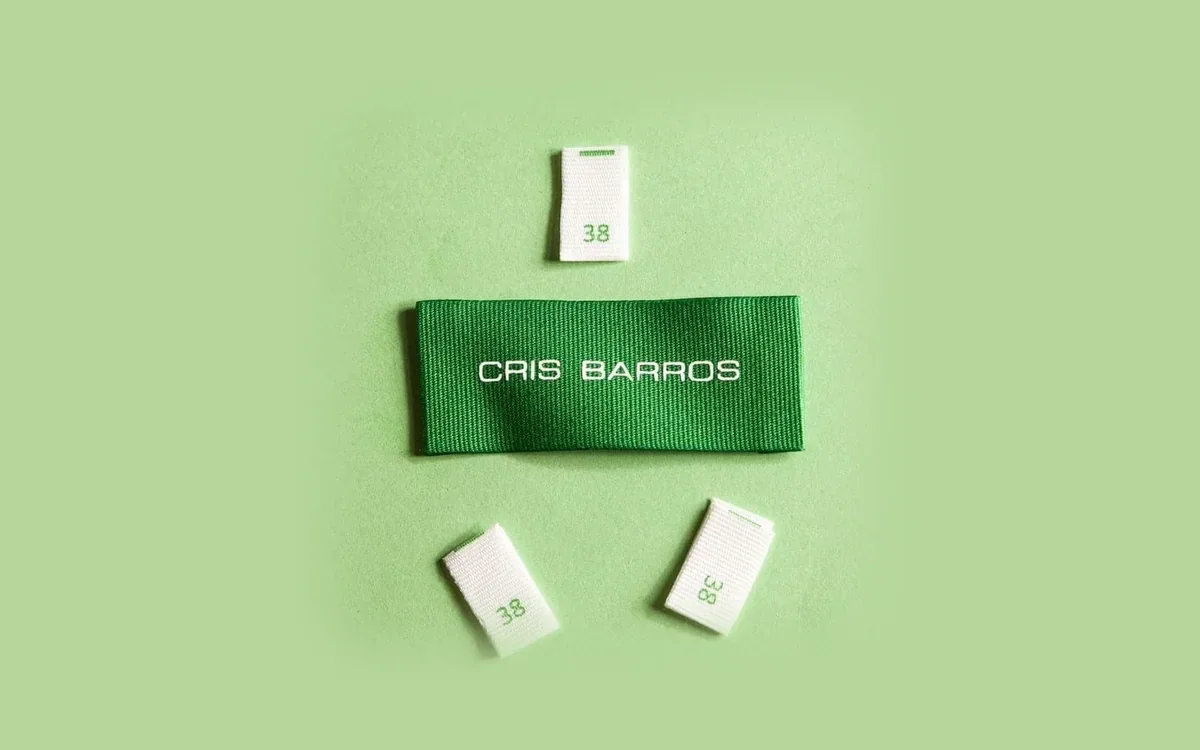
Size tabs are small because they carry only a few characters. Typical finished sizes are 10 × 15 mm, 12 × 20 mm, 15 × 15 mm and 15 × 20 mm. A tab with several size systems needs more room, usually around 20 × 30 mm or a second line. Remember that the cut length is longer than the finished size once the fold is added. Our label size guide explains how to calculate this.
The size itself should be the largest element on the tab. A single bold “M” reads instantly; a line such as “EU 40 / UK 12 / US 8” needs width and a clean, simple font.
Step 4: agree where it is sewn
- Back neck seam: a loop-fold or centre-fold tab placed below or beside the brand label. The standard for tops, shirts and knitwear.
- Flag beside the brand label: both ends caught in one seam so the tab stands slightly proud.
- Stitched across the brand label: a flat tab sewn over the lower corner of the main label.
- Built into the brand label: one brand label design per size. This removes a sewing step but multiplies the number of designs.
- Side seam or care label: common in trousers, skirts, underwear and swimwear.
- Inside back waistband: easy to find on bottoms.
Check with your sewing team before merging size and brand label. Many factories prefer a single brand label plus separate tabs, because the tabs can be reallocated quickly when the size mix changes.
Step 5: colour coding and the warehouse
Some brands give each size a different tab colour or a coloured border so that operators and warehouse staff can sort at a glance. It works well on large runs of basics. Keep the colour logic identical across seasons and record it in your trim specification so every factory follows it.
Step 6: split quantities across the run
Size curves are rarely even: M and L often sell twice as fast as XS or 3XL. Send us the planned breakdown per size and we will advise how one style’s total can be divided across the sizes. Order a reserve on the core sizes, because reprinting a single missing size later costs more time than a small buffer.
How we support you
Our design team prepares a digital proof of each tab, matches yarn or ink to your Pantone references and sends samples before production. Materials are available OEKO-TEX certified, with GRS recycled options, and delivery reaches the whole EU. See all options on our size labels page.
How small can a size tab be?
Finished tabs of 10 × 15 mm work well for a single size character. Tabs with several size systems usually need around 20 × 30 mm.
Should the size be woven or printed?
Woven tabs are the most durable and match a woven brand label. Printed tabs are more practical when you use many sizes or multi-country conversions.
How are European children’s sizes shown?
Usually by body height in centimetres in 6 cm steps, such as 86, 92 and 98, often with the age range added.
Can one style’s order be split across sizes?
In many cases yes. Send us your size curve and we will propose how the quantity can be divided across the sizes of that style.
Can size tabs be colour coded?
Yes. A different tab colour or border per size helps sorting on the line and in the warehouse, provided the colour code stays the same across seasons.