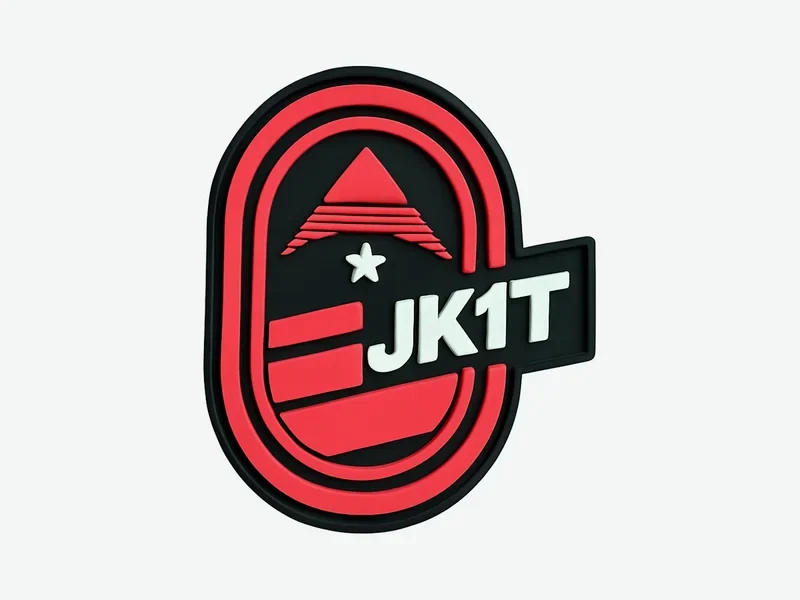
Custom silicone and rubber labels for clothing, moulded in 2D or 3D relief in Pantone-matched colours – for sewing on or heat-pressing, made in our own production in Bulgaria.
Some brands want a logo you can feel with your fingertips. Moulded labels turn artwork into a flexible, raised badge that stands out on a jacket sleeve, a backpack or a beanie. They are waterproof, colourfast and highly resistant to wear. As a silicone label manufacturer, we cut the moulds, mix the colours, fill, cure and inspect every label in-house, so repeat orders look the same season after season.
Silicone, rubber or PVC – what is the difference?
In everyday language “rubber labels”, “PVC patches” and “silicone labels” are used for the same product, but the materials behave differently. The right choice depends on the feel you want, the garment and how the label will be attached.
| Material | Feel and properties | Strengths |
|---|---|---|
| Soft PVC | Slightly firm, glossy to satin surface, crisp edges | Very abrasion resistant, strong colours, cost-effective; great for bags and outdoor gear |
| Silicone | Soft, elastic, smooth matt touch | Comfortable close to the body, heat tolerant, stays flexible in the cold; preferred for heat-applied labels and PVC-free products |
| TPU | Thin, light and flexible | Fine detail, bonds well to technical fabrics; used for slim heat-transfer badges |
2D or 3D relief
A 2D label is built from flat levels – usually a base, a raised logo and sometimes a raised border. It reproduces graphic logos and text cleanly and efficiently. A 3D label is made in a sculpted mould, giving rounded, bevelled or layered forms with a strong premium presence. 3D designs are thicker and their moulds take a little longer to prepare, but they are the most tactile option we offer.
Colours, effects and design rules
Each colour is filled into its own area of the mould, so the boundaries stay sharp and colours never run into each other. We match every colour to your Pantone references and can also produce transparent, metallic-effect, glitter and glow-in-the-dark compounds. Most designs use between two and six colours; more are possible.
To keep details crisp after moulding, plan lines of at least about 0.5 mm and text of roughly 2 mm in height. Our design team checks this automatically and prepares a technical drawing with dimensions, levels and Pantone codes for your approval.
Sizes and thickness
Moulded labels can follow almost any outline. These formats are good starting points:
| Size (mm) | Thickness (mm) | Typical placement |
|---|---|---|
| 20 × 20 | 1–1.5 | Sleeves, hems, caps, small accessories |
| 30 × 30 | 1.5–2 | Chest logos, beanies, childrenswear |
| 40 × 20 | 1–2 | Waistbands, pockets, side seams |
| 50 × 20 | 1–2 | Wordmarks on outerwear and bags |
| 50 × 30 | 1.5–2.5 | Jackets, backpacks, workwear |
| 60 × 40 | 2–3 | Bags, luggage, statement badges |
| Custom 3D | up to about 3–4 | Sculpted multi-level logos |
For proportions on different garments, see the label size guide.
Ways to attach the label
- Sew-on channel – a thinner flat border or groove around the edge guides the needle, so stitching sits neatly and the relief stays intact.
- Heat-press backing – a heat-activated adhesive layer bonds the label to the fabric with a heat press. The result is stitch-free and moves with stretch fabrics, ideal for sportswear.
- Fabric or adhesive backing – a woven or felt backing for stitching, or a pressure-sensitive adhesive for hard goods and packaging.
- Moulded loops and slots – for webbing, cords and zip pullers.
For heat-press labels, tell us the fabric composition. We test the adhesive on your fabric, because coated nylon, polyester and cotton each bond differently.
Where silicone labels work best
- Sportswear, swimwear and activewear, where heat-pressed silicone moves with the fabric
- Outerwear, ski jackets and softshells
- Backpacks, bags, luggage and outdoor equipment
- Caps, beanies and knitted accessories
- Childrenswear, with soft, rounded edges
- Workwear and uniforms that face heavy use
Care and durability
Moulded labels keep their colour and shape through repeated washing and do not fray or curl. For the longest life, wash garments inside out at the temperature on the care label, avoid ironing directly on the badge and keep tumble-drying temperatures moderate for heat-pressed labels.
From artwork to moulded labels
- Send your logo as a vector file – a sketch is also fine – with the size, colours and how you plan to attach the label.
- We prepare a technical drawing and digital proof, typically within 24–48 hours.
- A physical sample is moulded before bulk production so you can check colour, relief and feel.
- After sample approval, production typically takes 10–20 working days, with express options on request.
- Labels are delivered across the EU from Bulgaria.
Minimums are typically around 1,000 pieces per design – ask us about your project. Once a mould exists, reorders in the same design are straightforward: we keep the mould, the drawing and your colour references on file, which keeps each new batch consistent with the last and shortens the preparation stage. Colour variations of the same shape – for example a black and a white version of one logo – can often be produced from the same mould.
Quality and certification
Our raw materials are OEKO-TEX certified, an important point for childrenswear and skin-contact garments. Every batch is inspected for colour accuracy, fill, edge quality and dimensions. Looking for a different texture? Explore leather labels, metal labels, embroidered patches or flat heat transfer labels. Contact us at [email protected], on WhatsApp or Viber at +359 876 766 050, or through the contact page.
Frequently asked questions
Should I choose silicone or soft PVC?
Choose soft PVC for maximum abrasion resistance and strong colours on bags and gear. Choose silicone for a softer feel, heat application and PVC-free products.
Can moulded labels be applied without stitching?
Yes. Silicone labels with a heat-activated adhesive layer are applied with a heat press and show no stitching.
How thick is a 3D label?
Flat 2D labels are typically 1–2 mm thick; sculpted 3D designs usually reach about 3–4 mm.
What is the smallest text you can mould?
Text of roughly 2 mm in height and lines of about 0.5 mm stay crisp. Our designers adjust finer details in the proof.
Do you make a sample first?
Yes. As the manufacturer we mould a physical sample before bulk production for your approval.