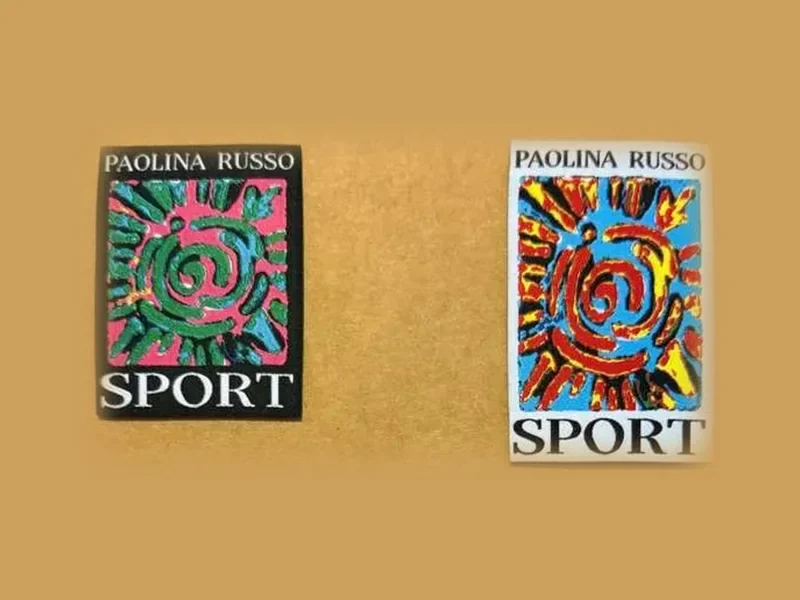
Custom heat transfer labels for clothing – tagless neck prints, size marks and logo transfers that bond to the fabric under heat and pressure. We are the manufacturer: inks, carrier papers and adhesives are printed, combined and tested in our own plant in Bulgaria.
How a tagless label works
A heat transfer label is printed in reverse onto a carrier, coated with a heat-activated adhesive and then pressed onto the garment. When the carrier is peeled away, the print stays on the fabric. Brand name, size, fibre composition and care symbols sit flat inside the neck or on the side seam, with no stitched edge against the skin and nothing for the wearer to cut off. That comfort is why heat transfer neck labels are widely known as tagless labels, and why they have become the standard in T-shirts, base layers, underwear and children’s clothing.
Types of heat transfer we make
Screen-printed transfers
Our most requested option for neck labels. Ink layers are screen-printed onto release paper or film, then backed with hot-melt adhesive. The result is a thin, flexible film with sharp edges and strong opacity, even on dark fabrics. Neck prints usually use one to three spot colours; logos can use more.
Silicone and high-density transfers
Silicone builds a soft-touch, slightly raised layer with excellent stretch recovery – a strong fit for performance and compression wear. High-density (HD) transfers add height for crisp, three-dimensional edges on logos. For a fully moulded badge, see our silicone labels.
Reflective transfers
Glass microbeads in the print return light towards its source, so logos and details glow in headlights. They are popular on running, cycling and outdoor garments. Decorative reflective prints add visibility; certified high-visibility workwear follows its own PPE standards.
Sizes for neck prints and logos
| Use | Typical size (mm) | What it usually shows |
|---|---|---|
| Size-only mark | 15 × 15, 20 × 20 | Size |
| Compact neck print | 30 × 30, 35 × 35 | Logo and size |
| Standard tagless label | 40 × 40, 50 × 50 | Logo, size, composition, care symbols |
| Wide neck label | 60 × 40, 70 × 50 | Full information in 2–3 languages |
| Large neck or back print | 80 × 60 | Extended text, several languages |
| Logo transfer | 30 × 30 to 100 × 100 | Brand logo on chest, sleeve or hem |
A practical approach for a size run is one neck layout with an interchangeable size field, which keeps artwork simple and reorders fast. Custom sizes are always possible – our label size guide shows how much information fits in each format.
Design and colour options
- Spot colours matched to Pantone references, including white, black and metallic-effect inks.
- Care symbols, fibre composition, size, country of origin and batch codes in one layout.
- Multilingual text for EU markets, arranged by our designers to stay legible at small sizes.
- Matt or soft-touch surfaces, raised silicone or HD effects, and reflective details.
- QR codes printed directly on the transfer – see QR and DPP labels.
On sublimated or dark-dyed polyester, dye can migrate into light inks and tint them. Let us know the fabric in advance and we will add a blocker layer or select a suitable ink system.
Applying the transfer: temperature, time, pressure
Every transfer is defined by three settings. As a general guide, many textile transfers are pressed at around 130–165 °C for 8–15 seconds at medium to firm pressure, with the carrier peeled hot or cold depending on the product. Low-temperature adhesives are available for heat-sensitive fabrics such as some polyester and elastane blends. Each order comes with a parameter sheet, and we recommend a test press on your production fabric, because weight, dye and finish all influence the bond.
| Fabric | Suitability |
|---|---|
| Cotton and cotton–polyester blends | Excellent with standard adhesive |
| Polyester and sublimated polyester | Very good; blocker layer recommended for light inks |
| Elastane blends, compression fabrics | Very good with stretch or low-temperature adhesive |
| Nylon | Good with a matched adhesive |
| Coated, water-repellent or open-textured fabrics | Possible with a specific adhesive after testing |
Where tagless labels make the biggest difference
- Sportswear and base layers – the print stretches with the fabric and stays invisible under tight layers.
- Babywear and kidswear – a smooth surface for sensitive skin, with information that cannot be cut off.
- T-shirts and basics – a clean, modern finish inside the neck.
- Underwear and lingerie – flat and light, with no seam to feel.
- Promotional and corporate wear – logos and neck prints applied quickly in production.
Because composition and care stay permanently on the garment, tagless labels also help you keep mandatory information accessible under Regulation (EU) No 1007/2011. If you need extensive multilingual text, a small sewn care label in the side seam can carry what does not fit in the neck print.
From artwork to transfer roll
- Send your logo, label text, size list and the fabric you will press on.
- Our designers build the layout with care symbols and send a digital proof, typically within 24–48 hours.
- A physical sample can be produced for a test press on your garment.
- After approval, production typically takes 10–20 working days.
- Transfers are supplied on sheets or rolls ready for your heat press, delivered across the EU without customs; express options on request.
Minimums usually start at 1,000 pieces per design – ask us about splitting quantities across sizes.
Wash durability and certification
Applied correctly, our transfers are made to withstand repeated domestic washing without cracking or peeling. Durability depends on the right adhesive for the fabric, following the press settings and washing the garment inside out at the temperature on its care label. Our production is OEKO-TEX certified and uses industrial-grade materials tested for harmful substances, so you can build products intended for babies and sensitive skin with confidence.
Frequently asked questions
Can I apply heat transfer labels with my own heat press?
Yes. We supply transfers on sheets or rolls with a parameter sheet for temperature, time and pressure, and recommend a test press on your fabric.
Will the neck print crack on stretchy fabrics?
With a stretch adhesive and the right ink, the print moves with elastic fabrics. Silicone transfers offer particularly good stretch recovery.
Why do white inks sometimes turn pink on polyester?
That is dye migration from sublimated or dark-dyed polyester. Tell us the fabric and we will add a blocker layer or choose a suitable ink.
How much information fits on a 40 × 40 mm label?
Typically logo, size, fibre composition and care symbols. For two or three languages, a 60 × 40 or 70 × 50 mm layout gives more room.
Are your transfers suitable for babywear?
Yes. Our production is OEKO-TEX certified and our materials are tested for harmful substances.
Tell us your fabric, garment and print size and we will propose the right transfer: [email protected], WhatsApp/Viber +359 876 766 050, or our contact page.